
Building Med-Tech Without a Big Budget: Lessons from a Resource-Strapped Government Hospital
It was a humid afternoon in Mumbai, and the outpatient department of Sir J.J. Hospital was abuzz with activity. Patients lined the corridors, waiting for their turn. Amidst this familiar chaos, Dr. Ramesh, a young orthopedic surgeon, was in the middle of a routine examination when a faulty piece of equipment interrupted his flow. The splint meant to stabilize fractures, a basic yet crucial device, was malfunctioning, and replacements weren’t readily available. Frustrated, Dr. Ramesh knew this wasn’t a one-off issue. With limited funding and resources, government hospitals often struggled to provide even the simplest medical devices. Yet, necessity is the mother of invention, and Dr. Ramesh found himself at the crossroads of innovation.
This scenario might seem daunting, but it’s the breeding ground for med-tech innovation in resource-constrained environments like many Indian government hospitals. So, how do you push med-tech development when you’re strapped for cash and resources? Let’s explore some practical steps and real-life lessons from those who have walked this path before.
1. Start with a Ward-Level Problem
The first step in building med-tech solutions is identifying a tangible problem that affects your daily clinical practice. Dr. Ramesh’s issue with the splint wasn’t unique. Many clinicians face similar frustrations, such as delays due to equipment shortages or inefficiencies in existing devices. The key is to zero in on a specific, recurring problem. This focus not only streamlines your efforts but also ensures your innovation is directly relevant and impactful.
Identify a problem that’s specific and recurring in your daily practice. This will be your innovation starting point.
Consider the following questions to pinpoint such problems:
- What equipment or process frequently hinders my work?
- Is there a common complaint among my peers about a particular device?
- Have patients voiced concerns about their experience with certain medical tools?
2. Prototype with What’s Available
Once you’ve identified the problem, the next step is to prototype. Contrary to popular belief, you don’t need cutting-edge technology or a hefty budget to start. In fact, many successful innovations have emerged from makeshift labs using everyday materials. Consider the story of the Open Source Imaging Initiative, which began with basic materials and an idea to democratize MRI technology.
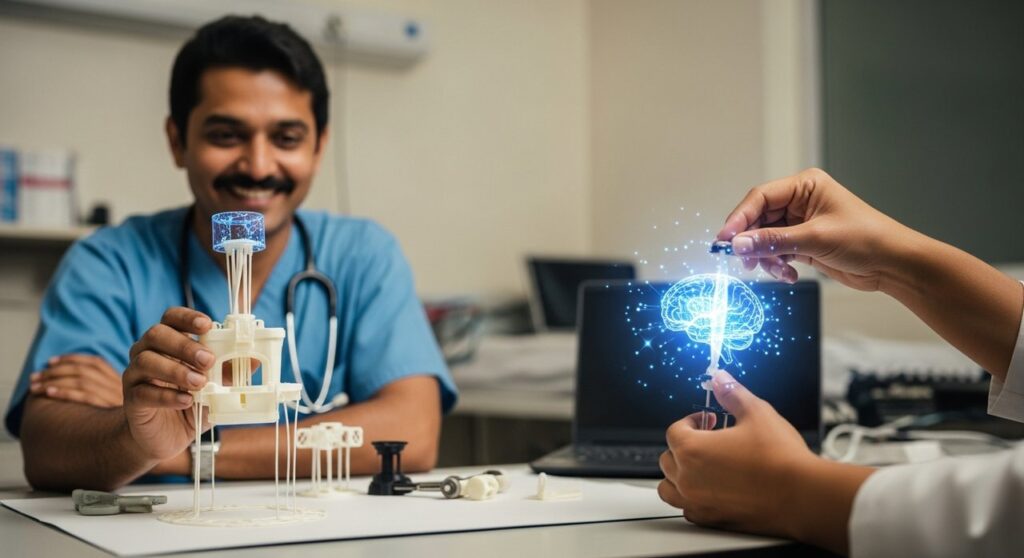
Dr. Ramesh, inspired by similar stories, took to 3D printing to create a new type of splint. Collaborating with MICE Labs, he used affordable materials and local resources to design a prototype that was not only functional but also cost-effective.
- Gather available resources and tools. Think outside the box, use what’s readily accessible.
- Sketch your design and iterate quickly. The first model doesn’t have to be perfect.
- Test it in a controlled environment. Gather feedback from colleagues and refine the design.
For those new to prototyping, resources like the MICE Labs Playbook can offer invaluable guidance.
3. Leverage Open-Source Platforms
Open-source technology can be a game-changer for med-tech innovation, especially when funds are limited. The open-source model allows developers to share and build upon each other’s work, significantly cutting down on both time and cost. Projects like OpenBCI have shown how open-source platforms can revolutionize medical device development by providing access to essential designs and software at no cost.
Dr. Ramesh utilized open-source designs to refine his splint prototype, ensuring it met clinical standards without the hefty price tag. This collaborative approach not only fostered innovation but also built a community of like-minded innovators eager to improve healthcare.
4. Navigate the Regulatory Landscape
One of the most daunting aspects of med-tech development is understanding and complying with regulatory requirements. In India, the Central Drugs Standard Control Organization (CDSCO) governs medical devices, and navigating this landscape is crucial for any innovator.
While the process may seem intimidating, it’s important to remember that many others have successfully navigated it. Dr. Ramesh consulted with regulatory experts and attended workshops to understand the nuances of medical device regulations. This preparation was critical in ensuring his device was compliant and ready for wider use.
Don’t let regulatory hurdles deter you. Seek guidance and educate yourself on the necessary steps for compliance.
5. Build a Supportive Network
Innovation does not happen in isolation. Building a supportive network of mentors, fellow innovators, and industry experts can provide the guidance and resources needed to bring your idea to life. Platforms like MICE Labs offer opportunities to connect with experienced professionals who can provide invaluable insights and support.
Dr. Ramesh found mentors through MICE Labs who had experience in med-tech innovation. Their advice and encouragement were crucial in overcoming challenges and refining his prototype. Additionally, connecting with other innovators provided a platform to share knowledge and collaborate on solutions to common problems.
6. Take Advantage of Local Manufacturing
Local manufacturing can drastically reduce costs and improve the accessibility of your medical device. By partnering with local manufacturers, you can ensure your device is produced affordably and sustainably. This approach not only benefits your project but also supports the local economy.
Dr. Ramesh collaborated with a Mumbai-based manufacturer to produce his splint at scale. This partnership allowed him to keep production costs low and ensured a steady supply of devices to the hospital.
7. Embrace Iterative Improvement
Finally, remember that innovation is an iterative process. The first version of your device is unlikely to be perfect, and that’s okay. Embrace feedback and be willing to make improvements based on real-world use.
Dr. Ramesh regularly collected feedback from his colleagues and patients, using their insights to refine and enhance his splint design. This commitment to continuous improvement ensured the device remained effective and relevant over time.
Conclusion
Building med-tech solutions without a big budget is not only possible but incredibly rewarding. By focusing on real-world problems, leveraging available resources, and building a supportive network, you can transform bedside frustrations into innovative solutions. As Dr. Ramesh’s journey shows, the path may be challenging, but the impact on patient care and the healthcare system as a whole is well worth the effort.
So, the next time you encounter a persistent problem in the ward, remember that you have the tools and the tenacity to create change. Whether it’s a splint or a more complex device, your innovation could be the solution that transforms healthcare for the better.