
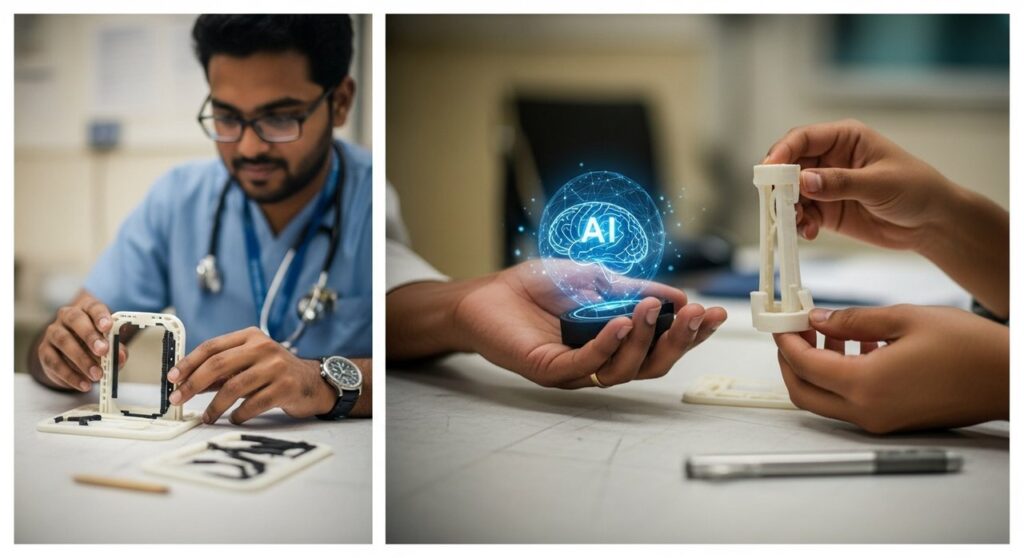
Crafting Affordable AI Tools in the Constraints of Indian Hospitals
Imagine standing in a bustling corridor of a government hospital in Tamil Nadu, where the air is thick with the anticipation of a long wait. Patients clutching paper folders, their faces a mix of hope and fatigue, shuffle towards a check-in desk. This is the daily reality for many Indian hospitals, where high patient volume and limited resources create a perfect storm of inefficiency. Now, imagine an AI tool that can cut through this chaos, directing patients to the right department on their first attempt. This isn’t a distant dream but a reality slowly taking shape in India’s healthcare system.
The Challenge of Scale and Complexity
Indian hospitals, particularly those in rural areas, grapple with unique challenges. High patient loads, limited staff, and resource constraints create an environment where inefficiencies thrive. The Aravind Eye Hospital in Madurai, for example, faces long wait times and misdirected patient referrals. It’s a microcosm of a larger issue plaguing the healthcare system.
Prithvi Parthasarathy, a neuroscience major from Penn, took on the challenge at Aravind Eye Hospital, utilizing his interdisciplinary education to develop an AI tool aimed at streamlining patient flow. His project was not just an academic exercise but a practical solution to a real-world problem, illustrating the potential for AI to transform healthcare delivery in resource-constrained settings.
Practical AI: Not Just for Silicon Valley
The notion that AI tools require massive budgets and Silicon Valley expertise is a myth that needs busting. Parthasarathy’s project demonstrates that with the right mindset and approach, AI solutions can be crafted within the constraints of Indian hospitals. His AI triage tool was developed by integrating existing patient records with a refined algorithm, rather than building from scratch. This approach not only reduced development costs but also ensured the tool was tailored to the hospital’s specific needs.
“AI in healthcare doesn’t have to be expensive or complex to be effective. It’s about smart integration of existing resources.”
Building the Solution: A Step-by-Step Guide
Creating affordable AI tools in Indian hospitals involves a series of strategic steps. Here’s how you can tackle it:
- Identify the Pain Points: Start by understanding the specific challenges faced by the hospital. This could be anything from patient routing inefficiencies to prolonged wait times. Engage with both staff and patients to gather insights.
- Utilize Existing Infrastructure: Work with the hospital’s existing data and systems. In Parthasarathy’s case, this meant leveraging patient records and refining the hospital’s basic routing algorithm.
- Develop a Prototype: Create a simple, workable version of your tool. This step is about functionality, not perfection. Test the prototype in a controlled setting, gather feedback, and refine.
- Train and Implement: Roll out the AI tool with thorough training for the staff. The success of the tool hinges on how well the hospital personnel understand and use it.
- Monitor and Iterate: Post-implementation, continuously monitor the tool’s performance. Collect data on patient flow improvements and identify any areas for further enhancement.
Overcoming Regulatory and Cultural Barriers
One of the significant hurdles in deploying AI in Indian healthcare is navigating regulatory requirements and cultural nuances. The National Medical Commission (NMC) guidelines dictate specific boundaries for AI use, particularly in patient care. However, these regulations shouldn’t deter innovation but guide it towards ethical and safe practices.
Parthasarathy’s project thrived by respecting these guidelines, ensuring the AI tool complemented rather than replaced human judgment. Additionally, his ability to engage with patients in their native language, Tamil, underscored the importance of cultural sensitivity in healthcare innovation.
Lessons Learned and Future Directions
Parthasarathy’s experience highlights several key lessons for aspiring innovators:
- Start Small, Think Big: Focus on a manageable project with clear, measurable outcomes. This approach allows for easier scaling and adaptation across different settings.
- Leverage Local Expertise: Collaborate with local healthcare professionals who understand the unique challenges and opportunities within the system.
- Iterate Relentlessly: Continual refinement and adaptation are crucial. The healthcare landscape is dynamic, and solutions must evolve in tandem.
Looking ahead, the future of AI in Indian healthcare is promising but requires a collaborative, informed approach. By embracing the potential of AI and adapting it to local contexts, Indian hospitals can enhance their efficiency and patient care, even within tight constraints.
FAQs
How can AI improve efficiency in Indian hospitals?
AI can streamline patient flow, reduce wait times, and ensure accurate referrals, thereby improving overall hospital efficiency.
What are the regulatory considerations for using AI in Indian healthcare?
The NMC Telemedicine Practice Guidelines and Code of Ethics provide a framework for the ethical use of AI, ensuring it complements human decision-making.
How can hospitals afford to implement AI tools?
By leveraging existing infrastructure and focusing on smart integration rather than building from scratch, hospitals can implement effective AI solutions within budget constraints.
Conclusion
The journey of integrating AI into Indian hospitals is not without its challenges, but it is a path worth pursuing. By focusing on practical, scalable solutions and respecting both cultural and regulatory landscapes, innovators like Prithvi Parthasarathy are paving the way for a more efficient and responsive healthcare system. The key is not to shy away from the constraints but to use them as a catalyst for creativity and improvement.