
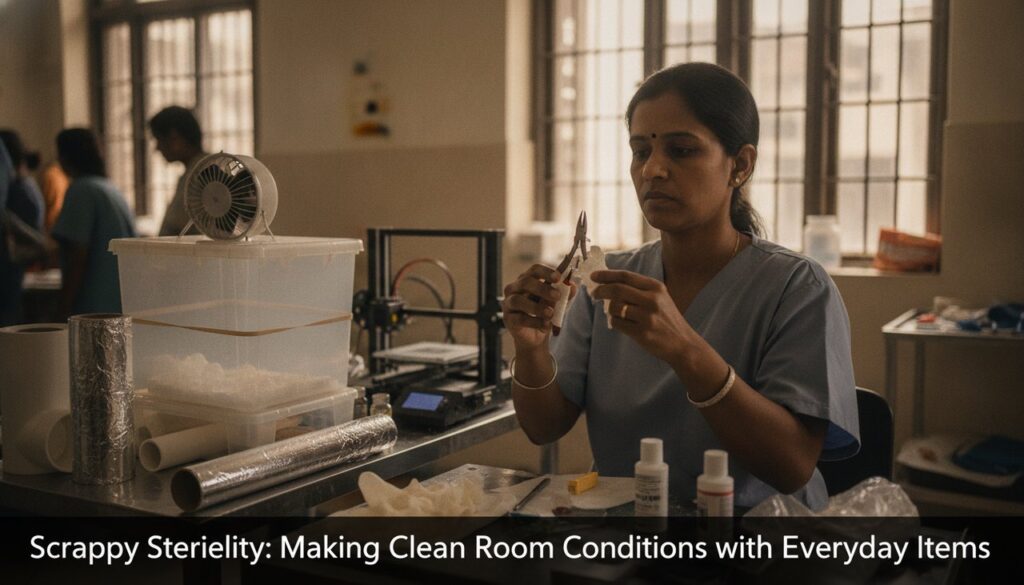
Scrappy Sterility: Making Clean Room Conditions with Everyday Items
In the heart of a bustling government hospital in India, a group of medical residents huddles together in a makeshift lab, surrounded not by high-end equipment, but by a collection of everyday items. Their task? Create a sterile environment using limited resources. It sounds counterintuitive, like trying to cook a gourmet meal with just a campfire and a tin can. Yet, this is the reality for many medical innovators working in resource-constrained settings. The surprising truth? It’s possible, and often necessary, to achieve sterility with a bit of ingenuity and a lot of determination.
The Reality of Resource Constraints
Consider this: in many government hospitals across India, resources are stretched thin. State-of-the-art cleanrooms and equipment are a luxury, not a given. Yet the demand for sterile environments remains high, especially in settings where even a single microbe can spell disaster. This isn’t just about avoiding infections; it’s about ensuring that life-saving procedures and innovations can occur without the looming threat of contamination.
In this context, sterility is not just a technical requirement but a challenge that demands creative solutions. It’s about leveraging what’s available to build what’s necessary. It’s about turning the ordinary into the extraordinary.
Redefining Sterility: The Scrappy Path
When conventional cleanroom setups are out of reach, it’s time to think outside the box. The solution lies in a combination of understanding the basics of contamination control and applying unconventional methods to achieve it. Here’s how:
- Material Mastery: Look around. Plastic sheeting, PVC pipes, and even shower curtains can be repurposed to create barriers that minimize contamination. These materials, while not traditional, can help in creating controlled environments when used correctly.
- Sealing Small Spaces: Airtight seals are crucial. Duct tape, silicone sealants, and even cling film can be used to seal off areas, preventing the entry of contaminants. It’s not about the material; it’s about how effectively it can be used to maintain a sterile boundary.
- Air Filtration Hacks: HEPA filters are ideal, but in their absence, layering fine mesh or using multiple layers of cloth can act as a rudimentary filter. Pair this with fans to create a positive pressure environment where the air flows out, not in.
- UV Sterilization: UV lights, while not a panacea, can be used to sterilize surfaces. Portable UV lamps, often found in household products, can be adapted for this purpose, providing an additional layer of protection against microbial growth.
The most critical step? Understanding that these solutions are not just stopgaps but viable methods that, when executed with precision, can achieve the desired sterility levels.
The Power of Ingenuity
Is it perfect? No. But in environments where options are limited, perfection is a luxury. What matters is functionality, and with the right approach, even scrappy solutions can meet stringent sterility requirements. This approach not only challenges the assumption that high-cost solutions are the only way forward but also opens new pathways for innovation.
True innovation emerges not from what you have, but from what you can do with what you have.
For the Indian medical community, this isn’t just an exercise in problem-solving; it’s a necessary evolution in how we view and achieve sterility. By embracing this mindset, we unlock the potential to innovate within our means, creating environments that are safe, functional, and remarkably effective.
Counterarguments and Rebuttals
Critics might argue that these methods lack the reliability of traditional cleanroom technology, and they wouldn’t be entirely wrong. However, in many cases, the choice isn’t between a traditional cleanroom and a makeshift solution; it’s between a makeshift solution and nothing at all. The key is not to replace but to supplement conventional methods with these innovative approaches where necessary.
Moreover, these strategies are not meant to replace existing standards but to provide alternative solutions when those standards are not within reach. The emphasis is always on safety and efficacy, ensuring that these improvised methods meet the necessary criteria for sterility.
Conclusion: A Provocation
The real question isn’t whether we can achieve sterility with everyday items, it’s whether we’re willing to redefine what sterility means in resource-constrained environments. In a world where innovation often feels out of reach, perhaps the most profound innovation is the willingness to challenge assumptions and embrace creativity. The future of sterile environments in Indian hospitals might not lie in costly equipment but in the hands of those who dare to innovate with what they have.
For more on innovating within resource constraints, explore Sterility on a Budget: Innovating with Limited Resources in Government Hospitals.