
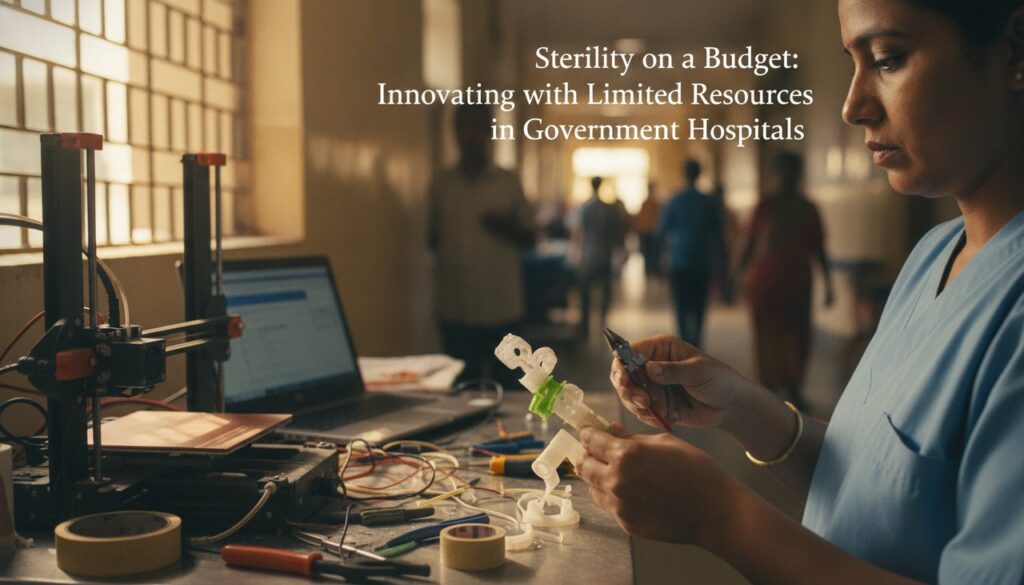
Sterility on a Budget: Innovating with Limited Resources in Government Hospitals
In a bustling government hospital in Mumbai, an overworked nurse balances trays of sterilized surgical instruments, a task as delicate as it is critical. But what happens when the autoclave breaks down, and funds for a replacement are months away? This is not a hypothetical scenario, it’s the reality faced by many healthcare providers in resource-strapped environments. The challenge is real, and so is the ingenuity it demands.
Frugal Innovation: The Art of Doing More with Less
Frugal innovation is not just a buzzword; it’s a necessity for many government hospitals. The concept involves creating cost-effective solutions that are both functional and sustainable. This approach thrives on creativity, resourcefulness, and a deep understanding of local needs and constraints. It’s about finding ways to deliver quality healthcare without the luxury of ample resources.
The Power of Lean Tools
One of the most effective strategies in frugal innovation is the use of lean tools. These are simplified versions of existing technologies that offer the same core functionalities at a fraction of the cost. For instance, Rice University’s bubble CPAP system significantly reduces the cost of neonatal respiratory care. Stripped of superfluous features, these devices are durable, portable, and easy to maintain, making them ideal for low-resource settings.
Lean tools are not just about cost-cutting; they’re about rethinking the essential elements of medical technology.
Opportunistic Solutions: Leveraging Everyday Technology
In the realm of frugal innovation, opportunistic solutions play a crucial role. These involve using widely available technologies in novel ways to address healthcare challenges. Consider the use of mobile phones to improve patient adherence to treatment protocols via SMS reminders. This simple yet effective method has been shown to increase patient compliance significantly, as evidenced by a study in Kenya.
Contextualized Adaptations: New Uses for Old Tools
Contextualized adaptations involve repurposing existing tools for new applications. A striking example is the use of urinary reagent strips for diagnosing cerebrospinal infections in settings where traditional diagnostic tools are unavailable. Another is the Solarclave, a solar-powered autoclave that uses mirrors to concentrate sunlight, achieving sterilization standards without electricity.
Challenges and Opportunities in Frugal Innovation
While frugal innovation offers promising solutions, it is not without its challenges. The primary hurdle is ensuring that these innovations are scientifically validated and safe for widespread use. Misguided innovations, like the once-popular use of cola drinks for rehydration, can do more harm than good if not properly evaluated.
Another challenge is adoption. Even when a frugal innovation is effective and affordable, it may not be readily accepted due to cultural, logistical, or social barriers. For example, the practice of flash heating breast milk to reduce HIV transmission is underutilized due to practical difficulties and social stigma.
Real-World Examples: Lessons from India
In India, government hospitals have been at the forefront of frugal innovation. The use of bicycle ambulances in rural areas, where traditional ambulances are impractical, showcases how local solutions can meet unique challenges. Similarly, building med-tech without a big budget in such hospitals has led to creative solutions that could inspire global practices.
Scalability and Sustainability
For frugal innovations to truly make an impact, they must be scalable and sustainable. This requires not only technical ingenuity but also a supportive ecosystem that encourages experimentation and collaboration. Organizations like PATH and WHO have been instrumental in promoting these innovations, but local governments and healthcare providers must also play an active role.
Moreover, it’s crucial to document and share successful innovations. The creation of a “Compendium of Good Ideas,” as proposed by experts, could serve as a valuable resource for healthcare providers worldwide, facilitating the spread of effective solutions.
Conclusion: A Call to Action
The path to innovation in resource-constrained healthcare settings is fraught with challenges, but it is also rich with opportunities. By harnessing the principles of frugal innovation, government hospitals can not only overcome their limitations but also set new standards for cost-effective healthcare delivery. The key lies in leveraging local insights, embracing creativity, and fostering an environment where innovation is not just possible but inevitable.
As healthcare providers, the responsibility is ours to turn these challenges into opportunities. The question remains: will we rise to the occasion and reimagine what’s possible in the face of scarcity?