
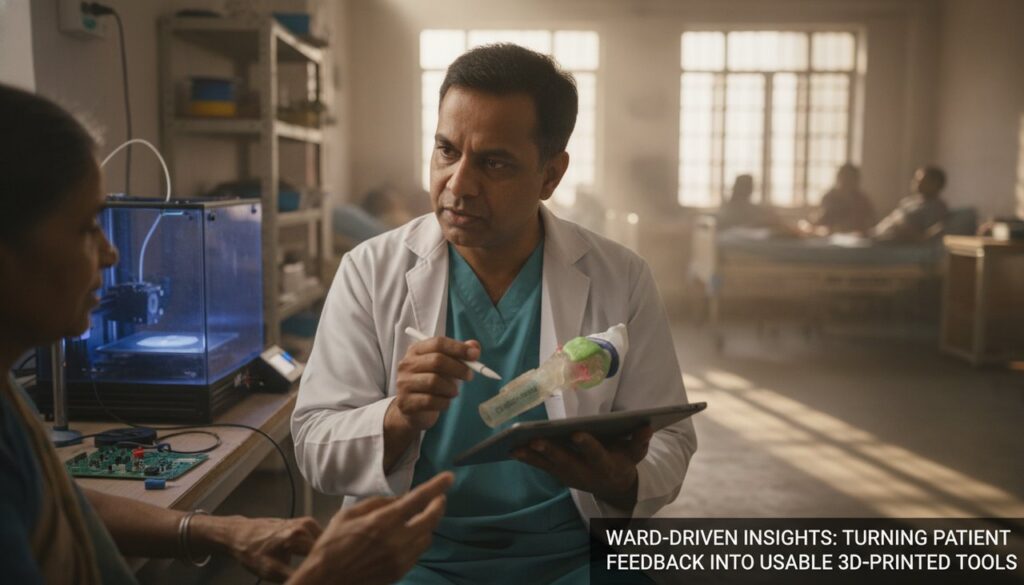
Ward-Driven Insights: Turning Patient Feedback into Usable 3D-Printed Tools
In a bustling hospital ward, where time is scarce and every decision counts, a surprising ally has emerged in enhancing patient care: the humble 3D printer. Not just for creating models of organs or surgical guides, 3D printing is now being harnessed to turn direct patient feedback into tangible solutions that address everyday frustrations in patient care. Let’s unravel the journey from bedside observations to practical 3D-printed tools and explore why this approach is more than just a tech novelty.
The Unseen Value of Patient Feedback
Patient feedback often comes through surveys or post-discharge interviews, capturing sentiments about care quality, wait times, and communication. But what if we could channel this feedback into creating physical solutions that improve the patient experience? A patient’s frustration with an uncomfortable brace or a cumbersome splint becomes an opportunity for innovation. By listening to these insights, healthcare providers are beginning to craft 3D-printed tools that are not only anatomically precise but also patient-centric.
3D printing in healthcare is not just about replicating existing tools, it’s about rethinking them from the ground up based on real-world use.
From Feedback to Prototype: A Clinician’s Journey
Consider the journey of a clinician inspired by patient feedback on the discomfort of standard-issue neck braces. The process starts with collecting detailed patient insights and then sketching a reimagined brace design. Using 3D modeling software, the design is refined and adjusted for individual anatomical nuances. The clinician doesn’t need an engineering degree to do this, just access to basic software and a willingness to iterate.
The next step involves creating a prototype using a 3D printer, which is often available in larger hospitals or through partnerships with local universities. The prototype is then tested and refined through direct patient interaction, ensuring fit, comfort, and functionality. This step might take multiple iterations, but it’s crucial to involve patients in testing to ensure the final product truly addresses their needs.
The Power of Personalization
What sets 3D printing apart in this context is its ability to create highly personalized solutions. Traditional manufacturing is often limited by economies of scale, producing large quantities of one-size-fits-all products. In contrast, 3D printing allows for bespoke solutions tailored to a patient’s specific anatomy and feedback. This personalization doesn’t just enhance comfort; it can significantly improve clinical outcomes by ensuring better compliance and effectiveness.
For example, a patient-specific 3D-printed surgical guide can reduce operation time and improve the accuracy of the procedure. Similarly, a custom-fitted orthopedic device can enhance mobility and recovery post-surgery. The potential for personalization in 3D printing is vast, and the direct line from patient feedback to product design is what makes this approach revolutionary.
Overcoming Barriers: Cost and Regulation
Despite its potential, the integration of 3D printing into clinical practice isn’t without challenges. Cost remains a significant barrier, particularly in resource-constrained settings. However, the cost of 3D printing has been decreasing, and when offset by the benefits of improved patient outcomes and satisfaction, the investment can be justified.
Regulatory hurdles also pose challenges. In India, the Central Drugs Standard Control Organization (CDSCO) oversees medical device regulation, and navigating this landscape can be complex. Clinicians must ensure that their 3D-printed devices meet safety and efficacy standards. This means engaging with regulatory bodies early in the design process and understanding the requirements for clinical trials and approvals.
Innovation in healthcare is as much about understanding regulation as it is about creating technology. Successful innovators master both.
The Future: More Than Just Tools
As 3D printing technology continues to evolve, its applications in healthcare will go beyond creating physical tools. Future innovations could include bioprinting tissues for regenerative medicine or creating complex drug delivery systems. However, the core principle remains the same: using technology to address specific, real-world problems identified through patient interaction.
Clinicians interested in exploring this path should start by identifying unmet needs in their daily practice. Whether it’s an inefficient process or a patient discomfort, these insights are the seeds of innovation. From there, leveraging resources like local maker spaces or university collaborations can provide the technical support needed to bring an idea to life.
The journey from ward-driven insight to 3D-printed solution showcases a shift in healthcare innovation, emphasizing that valuable solutions often spring from simple observations and the courage to act on them. As we continue to bridge the gap between patient feedback and practical solutions, we not only enhance care but also empower clinicians to become makers and innovators.
FAQs
What are the main barriers to using 3D-printed tools in healthcare?
The primary barriers include the cost of 3D printing technology, regulatory challenges, and the need for skilled personnel to design and produce the tools. However, costs are decreasing, and educational resources are becoming more available, making the technology more accessible.
How does 3D printing improve patient outcomes?
By creating personalized medical devices, 3D printing can improve fit, comfort, and functionality, leading to better compliance and clinical outcomes. It also allows for the rapid prototyping and testing of new designs, ensuring that the final product meets patient needs effectively.
Can clinicians without engineering backgrounds engage in 3D printing?
Yes, clinicians can engage in 3D printing by collaborating with engineers or using accessible design software and maker spaces. This collaboration allows clinicians to focus on the clinical aspects while leveraging technical expertise to bring their ideas to life.
For more insights on how to transform ward insights into working prototypes, refer to this guide and explore practical steps in this journey.