
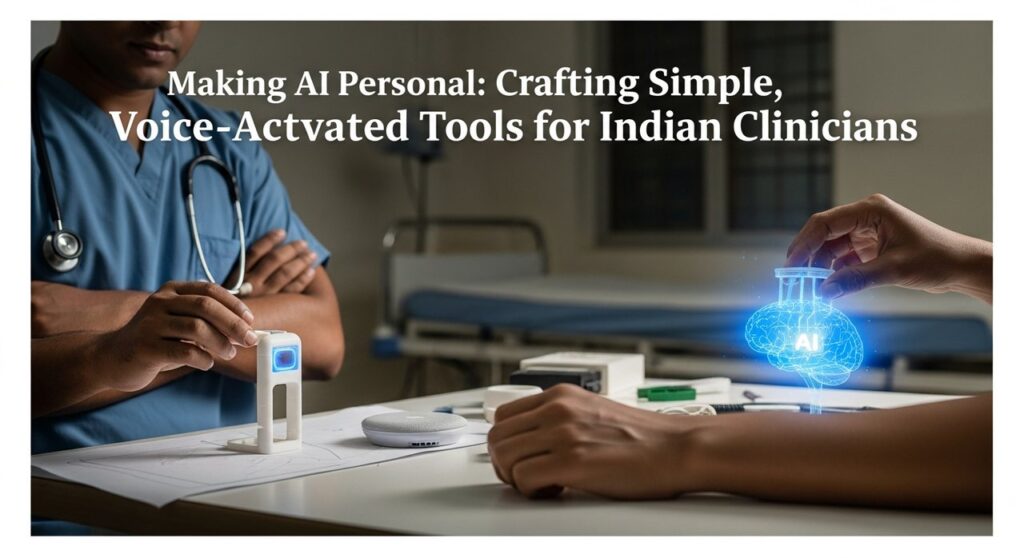
Making AI Personal: Crafting Simple, Voice-Activated Tools for Indian Clinicians
Picture a bustling government hospital in India. A clinician, overworked yet determined, juggles patient consultations and the relentless task of documentation. This isn’t just a drain on time; it’s a drain on the focus that patients deserve. Enter AI-powered Voice-to-Text Technology (AIVT), promising a solution to this age-old problem. Yet, as we explore the potential of AIVT, we find ourselves asking: Is it truly the panacea it’s touted to be, or are there pitfalls lurking beneath its shiny exterior?
The Myth: AI as a Magic Bullet
The belief that AI, and specifically AIVT, can seamlessly solve the documentation burden is widespread. It’s tempting to think that with the flick of a switch, AI can handle the tedious task of medical documentation, freeing clinicians to focus entirely on patient care. This is a comfortable notion, one that aligns with our desire for straightforward solutions to complex problems. Yet, does this belief hold up under scrutiny?
Facing Reality: The Nuances of Implementation
While AIVT tools indeed offer a significant promise, their integration into real-world settings isn’t as straightforward as one might hope. A systematic review found that while AIVT improved documentation efficiency and patient-centeredness, there were concerns about transcription errors and the technology’s applicability across diverse settings. In fact, studies reported that transcription inaccuracies might pose patient safety risks, necessitating vigilant oversight by healthcare providers.
Transcription errors remain a critical barrier to the safe implementation of AIVT in diverse healthcare settings.
Moreover, the large-scale application of AIVT tools has faced hurdles in terms of equity and integration. The majority of studies have involved participants from controlled settings, with limited diversity in patient populations. This raises questions about the generalizability of the technology in India’s varied healthcare landscape, where language diversity and resource constraints are significant factors.
What to Do Instead: A Path Forward for Indian Clinicians
So, how can Indian clinicians and healthcare innovators navigate these complexities to truly benefit from AIVT? Here are some steps:
- Localized Adaptation: Customize AIVT tools to accommodate regional languages and dialects. This not only enhances accessibility but also ensures documentation accuracy across diverse patient interactions.
- Incremental Integration: Start small, with pilot projects in select departments or clinics. Monitor outcomes closely, focusing on both efficiency and safety, before scaling up.
- Clinician Training: Provide comprehensive training for healthcare professionals on the use of AIVT tools. Emphasize the importance of cross-verifying AI-generated documentation for errors.
- Addressing Equity: Conduct trials in varied settings, including resource-limited environments, to gather data on the tool’s effectiveness and adaptability. This can offer insights into necessary adjustments for broader applicability.
- Continuous Feedback Loop: Establish a mechanism for clinicians to report issues and suggest improvements. This fosters a culture of iterative enhancement, crucial for the tool’s evolution.
It is imperative that any AI tool, including AIVT, is not viewed as a panacea but as a component of a broader strategy to enhance healthcare delivery. This means acknowledging and addressing the limitations head-on, rather than brushing them aside in the pursuit of technological advancement.
A Provocation: Rethinking AI’s Role in Healthcare
As we journey further into the realm of AI in healthcare, we must ask ourselves: Are we pursuing technology for technology’s sake, or are we genuinely committed to improving patient outcomes and clinician experiences? The distinction is critical. The integration of AI tools like AIVT should not be driven by the allure of cutting-edge technology but should be grounded in a clear understanding of clinical needs and constraints.
Ultimately, making AI personal means crafting tools that respect the complexities of healthcare delivery, especially within the unique context of Indian hospitals. It involves a commitment to innovation that is both thoughtful and practical, ensuring that technology serves as a true ally in the quest for better healthcare.
FAQs
What are the main barriers to implementing AIVT in Indian healthcare settings?
Major barriers include transcription accuracy, language diversity, and integration into existing workflows. Additionally, the equity of access across different healthcare environments is a concern that needs addressing.
How can clinicians ensure the safety and accuracy of AIVT-generated documentation?
Clinicians should receive thorough training on AIVT tools and be encouraged to verify AI-generated notes manually. Implementing a feedback system can also help improve the tool’s accuracy over time.
Is it possible to use AIVT tools in low-resource settings effectively?
Yes, with appropriate localization and adaptation, AIVT tools can be tailored to suit low-resource settings. This includes ensuring language compatibility and conducting pilot studies to refine the tool’s application.
For more insights on crafting AI tools within Indian hospital constraints, visit Crafting Affordable AI Tools in the Constraints of Indian Hospitals.