
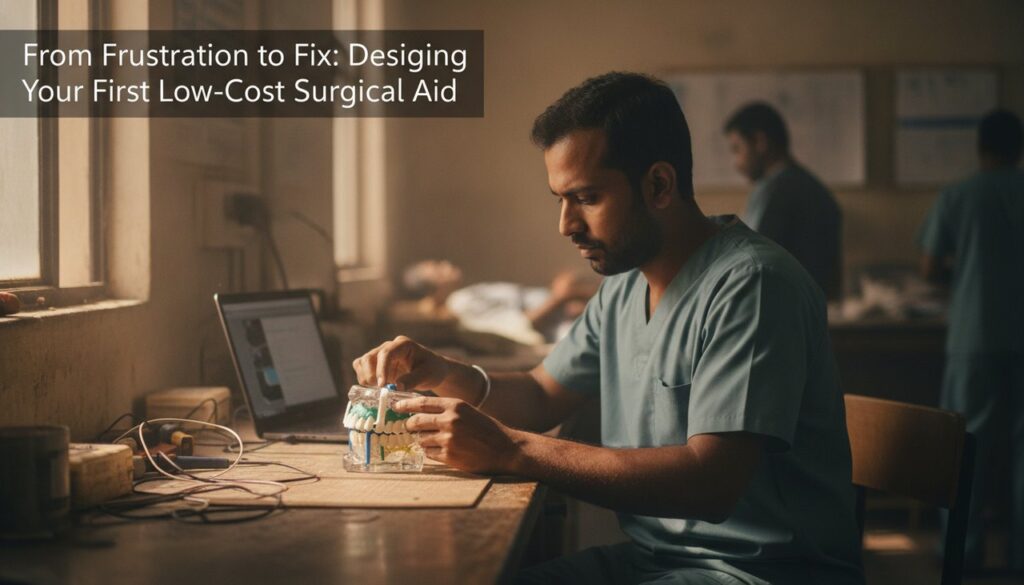
From Frustration to Fix: Designing Your First Low-Cost Surgical Aid
The operating room is tense. You’re a medical resident standing at the edge, watching as a senior surgeon manages a vascular anastomosis. The stakes are high; a misstep could lead to catastrophic bleeding. But what if this isn’t the first time you’ve seen this? What if you’ve practiced this exact procedure in a safe, controlled environment, without risking a patient’s life? This is where low-cost surgical aids come in, tools that enable you to practice and perfect your skills without the high costs or risks.
Start with the Problem, Not the Solution
Designing a low-cost surgical aid starts with identifying a specific problem you’re passionate about solving. It might be the lack of affordable simulators for practicing vascular anastomosis or the need for a better way to teach burn debridement techniques. The key is to pick a pain point that you’ve encountered firsthand. This personal connection not only fuels your motivation but provides the insights needed to create a truly practical solution.
“The most successful innovations solve a problem you’ve experienced yourself. Start there.”
Thinking Inside the Box: Use Local Materials
Once you’ve nailed down the problem, it’s time to get creative with materials. Resource constraints can actually drive innovation. Take the example of a simulation kit for vascular anastomosis. Instead of expensive synthetic models, consider using everyday items like latex tubing and disposable cups. These are not only cost-effective but also available in most local markets.
For instance, you can replicate the tactile experience of suturing a blood vessel using a segment of latex tubing adhered inside a cup. This setup mimics the constraints of a surgical field, providing a realistic practice environment. The lesson here is that the materials you need might already be within reach, you just need to look at them differently.
Prototype, Test, Iterate
With your materials in hand, it’s time to build a prototype. This isn’t a one-and-done process. Develop a basic version of your surgical aid and test it rigorously. Does it simulate the surgical technique accurately? Are there aspects that are too difficult to replicate? Use feedback from peers to refine your model.
Take, for example, the burn debridement simulation. Initially, you might use saran wrap and a blow dryer to create the appearance of blistered skin. After a few trials, you might realize that it doesn’t hold up well under repeated use. Iterating on this, you could switch to more durable materials like silicone sheets.
Understand the Costs and Constraints
Clearly outline the costs involved. It might be tempting to cut corners, but understanding the true cost of each component is crucial for sustainability. Calculate expenses in INR, consider the cost-effectiveness against imported alternatives, and identify areas where you can save without compromising quality.
In the Indian context, where government hospital budgets are tight, this is particularly crucial. Your surgical aid must be affordable not just for you but for the institutions that will use it.
Consider the Regulatory Pathway
In India, navigating regulatory approvals is a necessary step, and it’s often more complex than anticipated. Understanding the regulations by the Central Drugs Standard Control Organization (CDSCO) early in the design process can save you significant headaches down the line. While your initial prototype might not require approval, a commercial version likely will.
Document your design and testing processes meticulously. This record will be invaluable when you’re ready to seek regulatory clearance, turning what could be a frustrating barrier into a mere procedural step.
Share and Collaborate for Broader Impact
Once you’ve developed a working prototype, share your findings. Document the process and outcomes, and consider publishing them in platforms like Cureus Journal of Medical Science. Not only does this add to the global body of knowledge, but it also invites collaboration, which can lead to further improvements.
Collaborate with institutions and peers to refine your design and expand its reach. For instance, linking up with medical innovation labs like MICE Labs can provide additional resources and expertise to enhance your project.
FAQs
Why should I focus on low-cost solutions?
Low-cost solutions are essential for making surgical training accessible in low-income and resource-limited settings. They democratize education, allowing more individuals to gain hands-on experience without prohibitive costs.
How do I get started if I have no engineering background?
You don’t need an engineering degree to innovate. Start small, use available resources, and focus on solving one specific problem. Collaborate with peers from different backgrounds to fill in the gaps in your knowledge.
What if my first prototype fails?
Failure is a step towards success. Use each setback as a learning opportunity. Gather feedback, understand what went wrong, and iterate. The key is persistence and learning from each iteration.
In the end, designing your first low-cost surgical aid is about more than just creating a tool, it’s about shifting your mindset. By focusing on practical solutions, using local resources, and understanding the constraints, you can transform frustration into innovation. Remember, the most profound changes often start with the simplest ideas and the courage to pursue them.