
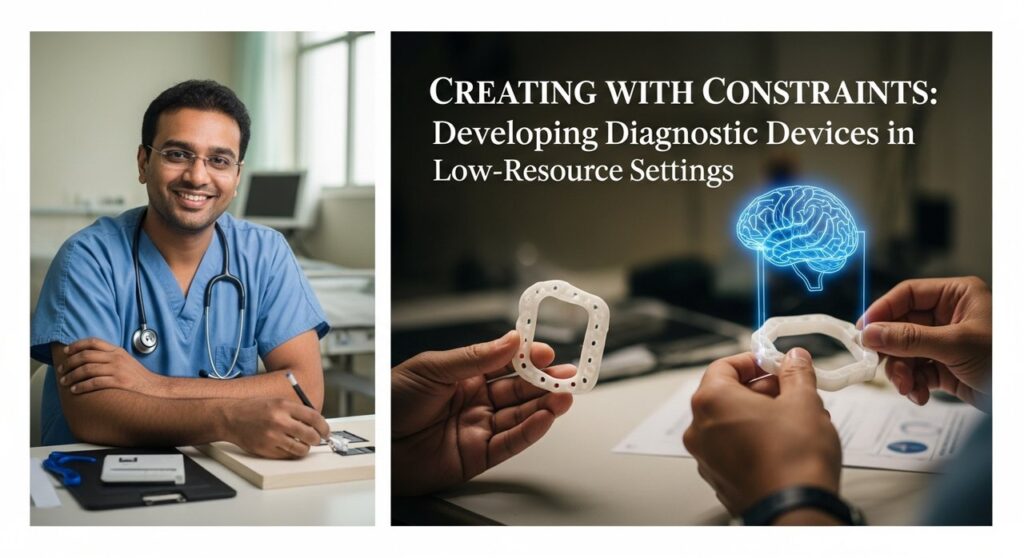
Creating with Constraints: Developing Diagnostic Devices in Low-Resource Settings
The stethoscope was silent. The patient lay on the examination table, her symptoms clear but diagnosis elusive. Without a reliable diagnostic device at hand, the doctor was left to make a judgment call that felt more like a guess. In many low-resource settings, this is not an occasional frustration, it’s a daily reality. As clinicians, especially in Indian government hospitals, we often find ourselves juggling between the need to diagnose accurately and the limitations of available technology.
What if we could develop diagnostic devices specifically designed to thrive in these challenging environments? What if the constraints, lack of funds, unstable electricity, and limited technical support, could be the very things that drive innovation?
Understanding the Context: More Than Just a Lack of Resources
It’s easy to attribute the challenges of developing medical devices for low-resource settings purely to financial constraints. However, the issue is more nuanced. According to a World Health Organisation (WHO) report, up to 70-90% of donated medical devices in lower-income settings are non-operational or broken. This isn’t just about money; it’s about context.
Low-resource settings are often characterized by harsh environmental conditions such as dust, humidity, and high temperatures, which can render sophisticated equipment useless. Inadequate infrastructure, including unreliable power and water supplies, further complicates the situation. In this context, a device’s durability and simplicity become critical factors in its usability and longevity.
Designing for low-resource settings isn’t a matter of stripping down high-tech solutions; it’s about building with a mindset that embraces constraints as opportunities for creative problem-solving.
Frugal Innovation: The Path to Sustainable Solutions
The concept of “frugal innovation” has gained traction as a practical approach to developing medical devices for low-resource settings. This involves creating cost-effective, robust, and user-friendly devices that meet essential healthcare needs without unnecessary complexity. An excellent example is the development of blood glucose monitors tailored for the Indian market, which prioritized affordability and ease of use over advanced features.
Frugal innovation is not about cutting corners but about redefining the design process to focus on core functionalities. It’s about asking, “What is truly necessary?” and “How can we make this work with what we have?” This mindset is crucial when designing devices for environments where maintenance skills and spare parts are scarce.
The Design Process: From Problem to Prototype
Developing diagnostic devices for low-resource settings requires a systematic approach that begins with understanding the problem. This involves ethnographic research and stakeholder consultation to validate unmet healthcare needs. For instance, a team designing a portable diagnostic device for rural clinics might start with field visits to understand the working conditions and constraints firsthand.
- Identify the Need: Start by pinpointing a significant, unmet healthcare need through direct observation and interviews with local healthcare providers. This step ensures that the solution is relevant and targeted.
- Conceptualize Solutions: Brainstorm a wide range of potential solutions, considering various technology domains. The goal is to explore all possibilities, not just those within the team’s current expertise.
- Evaluate and Select: Assess the proposed solutions against criteria such as cost, usability, and feasibility. Prioritize concepts that can be realistically developed and implemented in the target setting.
- Prototype Development: Create a working prototype using locally available materials whenever possible. This phase involves iterative design and testing, incorporating feedback from field trials.
- Implementation and Feedback: Deploy the prototype in the field and gather feedback from end-users to refine the design. This step is crucial for ensuring the device meets practical needs and conditions.
Case Study: The Low-Cost Hemoglobinometer
Consider the development of a low-cost hemoglobinometer designed for use in rural health centers. Traditional hemoglobinometers require expensive reagents and complex maintenance, making them unsuitable for low-resource settings. By focusing on frugal innovation principles, the design team created a device that uses a simple, reusable cuvette and a robust photometric sensor, significantly reducing costs and simplifying maintenance.
This device was developed in collaboration with local healthcare providers, ensuring it met their specific needs. The team conducted field trials in several rural clinics, refining the design based on user feedback. The result was a practical, affordable diagnostic tool that improved anemia detection rates and patient outcomes.
Challenges and Opportunities
While the path to developing diagnostic devices for low-resource settings is fraught with challenges, it also offers significant opportunities for innovation. The constraints of these environments force us to think creatively and challenge conventional design paradigms.
One of the primary challenges is ensuring the sustainability of these innovations. Devices must be designed for longevity and ease of use, with minimal reliance on external resources. This requires a deep understanding of the local context and a commitment to user-centered design principles. Moreover, regulatory hurdles and the need for local manufacturing capabilities can complicate the development process.
The key to successful innovation in low-resource settings is partnership with local stakeholders, ensuring that solutions are not only practical but also culturally and economically viable.
The Way Forward: Building a Culture of Innovation
For clinicians and innovators in India and similar contexts, the journey from problem to prototype is not only feasible but necessary. The constraints we face should not deter us but rather inspire us to create solutions that are both innovative and practical.
At MICE Labs, we believe that the future of healthcare innovation lies in empowering local talent to design solutions that fit their unique contexts. By fostering a culture of creativity and resilience, we can turn the everyday frustrations of the ward into opportunities for groundbreaking advancements in medical technology.
As we continue to develop diagnostic devices that meet the needs of low-resource settings, we must remain committed to the principles of frugal innovation and user-centered design. By doing so, we can create a future where access to quality healthcare is not a luxury but a standard for all.