
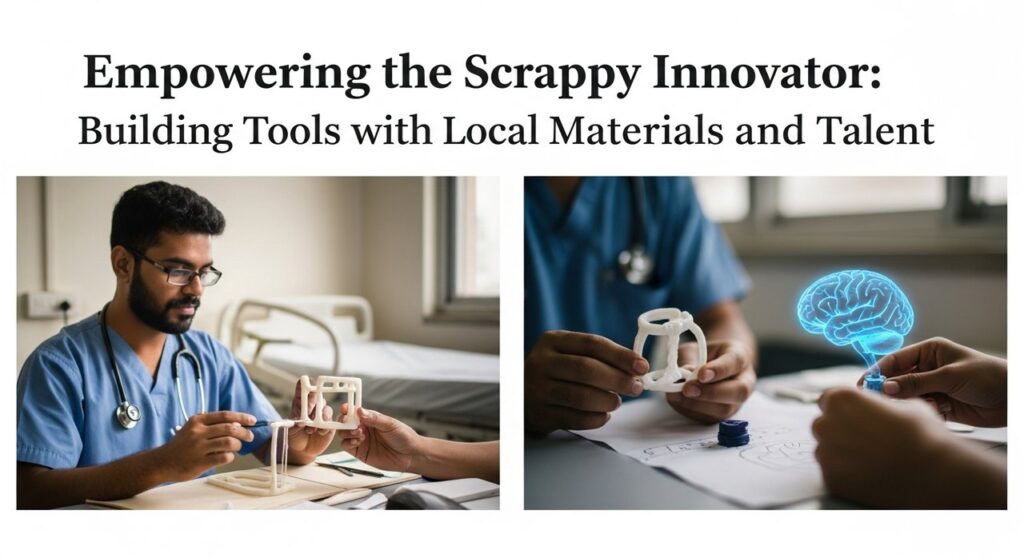
Empowering the Scrappy Innovator: Building Tools with Local Materials and Talent
In a bustling Mumbai hospital, a junior doctor stares at the outdated splint in his hand. It’s a relic, heavy and uncomfortable for patients, but the cost of importing better ones is prohibitive. He wonders, “Could I make something better with what’s around me?” This question is not just a fleeting thought; it’s the catalyst for innovation in environments where resources are scarce but ingenuity is abundant.
For the scrappy innovator, the pathway to creating effective medical tools is not paved with grants and glossy labs but rather with local materials, practical skills, and a deep understanding of immediate needs. It’s about leveraging what you have to solve problems that seem insurmountable at first. In India, where resource constraints are a daily reality, this approach is not just an option; it’s a necessity.
The Resourceful Path to Innovation
Contrary to popular belief, you don’t need a degree in engineering or hefty funding to start innovating in the medical field. What you need is a keen eye for unmet clinical needs and the willingness to experiment with available resources. This is the essence of the scrappy innovator.
“Innovation isn’t about the latest technology; it’s about solving real problems with whatever you have.”, A seasoned clinician-innovator
Consider the case of a group of young doctors at a government hospital in India who noticed that the lack of affordable patient tracking systems was causing inefficiencies and delays in patient care. Instead of waiting for a commercially available solution, they developed a low-cost patient tracker using simple RFID tags and locally-sourced electronic components. This system has since improved patient flow and reduced wait times significantly.
Steps to Start Innovating Today
- Identify a Real Problem: Spend time observing the day-to-day challenges faced by patients and healthcare professionals. Note down specific issues that recur and think about why they persist. This step is crucial; without a genuine problem to solve, innovation lacks direction.
- Gather a Diverse Team: Collaboration is key. Bring together people with different skills and perspectives. Nurses, technicians, and patients can provide insights that a single person might miss. This diversity fuels creativity and ensures that solutions are practical and user-friendly.
- Prototype with Local Materials: Use what’s available. Whether it’s 3D printing for creating models or using everyday items to simulate more complex components, prototyping doesn’t have to be expensive. Experimentation is your playground, and failure is just another step towards success.
- Test in Real-World Conditions: Once you have a prototype, test it in the environment where it will be used. Pay attention to how real users interact with it and gather feedback. This step is more about observing and less about defending your design.
- Iterate and Improve: Based on feedback, refine your design. This cycle of testing and improving is ongoing and essential. The most successful innovations are rarely perfect on the first try.
The most critical step? Identifying a real problem. Without it, even the most elegant solutions will fall flat. It’s the anchor that keeps the innovation process grounded in reality.
Challenges on the Scrappy Path
While the scrappy path to innovation is accessible, it is not without its challenges. Regulatory hurdles, especially in healthcare, can be daunting. The CDSCO regulatory reality in India, for example, requires careful navigation to ensure compliance without stifling creativity. Additionally, maintaining sterility and ensuring the safety and efficacy of new devices are non-negotiable requirements.
Another significant challenge is the skepticism that often accompanies low-cost innovations. There’s a prevailing belief that cheaper means inferior, which can be a hurdle in gaining acceptance for locally-developed solutions. This perception needs to be addressed head-on, with a focus on demonstrating the effectiveness and reliability of the innovations.
The Way Forward
For the scrappy innovator, the journey from idea to implementation is as much about mindset as it is about skillset. It requires a shift from dependency on external solutions to a belief in one’s ability to create impactful tools from limited resources. This mindset is not just empowering; it’s transformative.
“The future of healthcare innovation lies not in the hands of a few but in the collective ingenuity of many.”
By embracing local talent and materials, innovators can create solutions that are not only affordable but also tailored to the specific needs of their environment. This approach not only addresses immediate challenges but also sets the stage for sustainable, scalable innovations that can be applied in similar contexts worldwide.
FAQs
What materials can be used for prototyping medical devices locally?
Materials like PLA for 3D printing, PVC pipes, and electronic components like Arduino boards are commonly used. The key is to use materials that are readily available and easy to work with.
How can one ensure that a locally developed medical device meets safety standards?
Engage with regulatory bodies early in the development process to understand the requirements. Conduct thorough testing and documentation to ensure compliance with safety standards.
Is funding necessary for all types of medical innovations?
Not always. Many innovations can start on a small scale with available resources. However, for scaling up or mass production, seeking funding might become necessary.
The path of the scrappy innovator is paved with challenges, but it is also filled with opportunities to make meaningful changes in the healthcare landscape. By focusing on real problems and using local resources, you can create solutions that not only work but also inspire others to follow suit. The journey is tough, but the impact is worth every ounce of effort.