
Learning from the Ward: Designing Low-Cost Tech to Ease Diagnostic Delays
In the dimly lit corridors of government hospitals in India, where resources stretch thin and the queue of waiting patients seems endless, lies an opportunity for innovation. One might think that the lack of funds is the primary barrier to improving healthcare diagnostics. But the real hurdle is not just about costs; it’s about designing tools that work within the existing system constraints and gaining the trust of those who use them.
The Myth of Low-Cost Equals Low-Value
There’s a pervasive belief that low-cost solutions are inherently low-value, particularly in the context of healthcare diagnostics in developing countries. This assumption often drives the design of rapid diagnostic tests (RDTs) that prioritize cost-cutting over usability and reliability. However, as a study of clinicians in Kenya reveals, this is a misguided approach. Clinicians, those on the frontline of patient care, value reliability and standardization over mere affordability. They understand that a test that saves money but yields unreliable results is not a solution; it’s a liability.
The primary concern for clinicians is not the cost of the test itself, but its reliability and the confidence it inspires in both the healthcare provider and the patient.
Reality Check: Reliability and Trust Over Costs
Let’s dismantle the myth: affordability does not equate to value. In healthcare, where stakes are high, the reliability of diagnostic tools is paramount. A case study in Kenya highlighted that while clinicians appreciated the speed and cost-effectiveness of RDTs, their primary concern was the test’s dependability. The implication is clear, diagnostic tools must be designed with a focus on accuracy and consistency to be truly valuable.
Trust in technology plays a significant role in its adoption. A low-cost but unreliable test not only fails to gain trust but also risks eroding the credibility of the healthcare provider. For RDTs to be embraced, they must prove their worth not in isolation but within the workflow of actual clinical settings. This means understanding the constraints and realities faced by healthcare workers in resource-limited environments.
What to Do Instead: A User-Driven Design Approach
To develop diagnostic tools that truly serve their purpose, a shift towards a user-driven design approach is necessary. Here’s how:
- Engage with Stakeholders: Begin by involving the end-users, clinicians, nurses, and technicians, in the design process. Their insights can reveal critical pain points and help prioritize features that matter most in real-world settings.
- Focus on Reliability and Usability: Instead of cutting corners to reduce costs, invest in making the devices reliable and easy to use. This could mean simplifying the procedure or ensuring the test can withstand the environmental conditions typical in rural clinics.
- Iterative Testing and Feedback Loops: Deploy prototypes in actual clinical settings and gather feedback. Use this data to refine the design. The goal is a device that seamlessly integrates into the existing workflow and meets the clinician’s standards for accuracy.
- Local Manufacturing and Support: Develop manufacturing capabilities locally to reduce costs and ensure the availability of parts and support. This not only lowers the price but also builds trust, as local production can be perceived as more accountable.
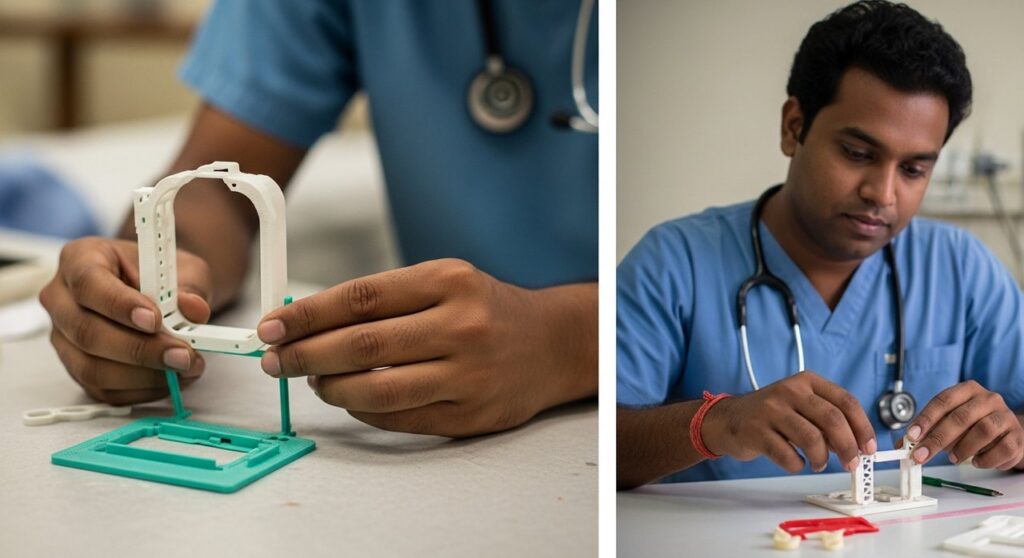
Consider the example of MICE Labs’ approach, which focuses on designing solutions from ward ingenuity. This method recognizes the value of user experience and local context in creating effective solutions. For more on this approach, see Suturing Solutions: Designing Low-Cost Alternatives from Ward Ingenuity.
Encouragement with Teeth: The Hard Thing Is Doable
Designing low-cost, reliable diagnostic tools is not an insurmountable challenge. By shifting the focus from mere cost to usability and reliability, innovators can create tools that not only fit within the budget constraints of developing countries but also enhance the quality of care. This is not about cheerleading the impossible; it’s about showing the concrete steps needed to move from problem to prototype to product.
At the heart of this shift is a change in mindset, valuing the input of those who will use these tools daily. It’s about creating a feedback loop that continuously improves the product based on real-world use cases. As a clinician or an innovator, your role is pivotal. By engaging with the design process, you become a part of the solution. And remember, you don’t need an engineering degree or a grant to start innovating. Sometimes, all it takes is a keen eye for the problems you face daily and a willingness to work towards a practical solution.
For those ready to take the first step in designing their own low-cost surgical aid, MICE Labs offers guidance on getting started. You can explore more on this topic at From Frustration to Fix: Designing Your First Low-Cost Surgical Aid.
The path to innovation in healthcare is laden with challenges, but it’s also ripe with opportunities for those ready to embrace a user-centered approach. The next great diagnostic tool might just come from the wards of a resource-constrained hospital, where necessity breeds ingenuity.