
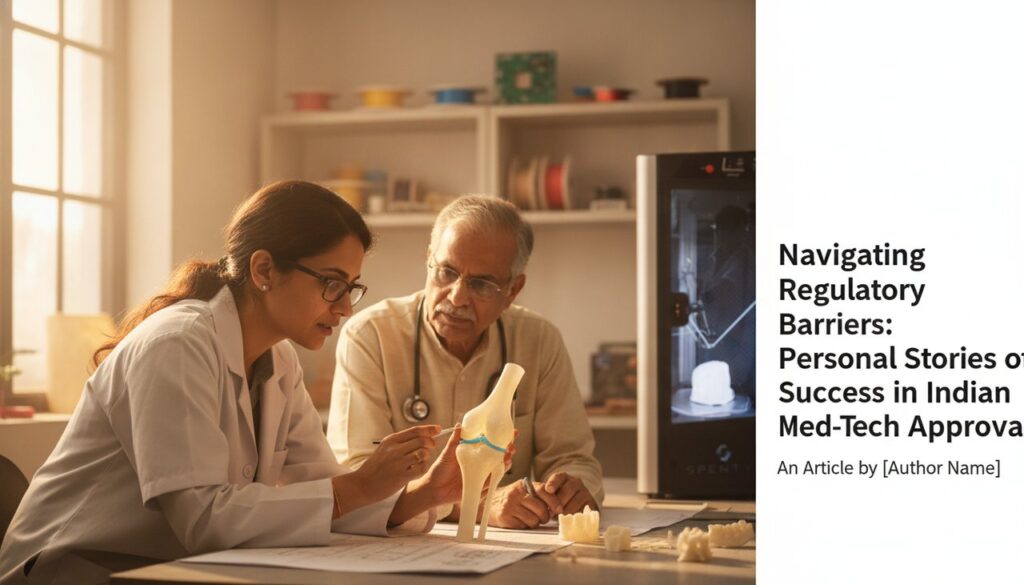
Personal Triumphs in Tackling Indian Med-Tech Regulatory Hurdles
In a bustling hospital in Mumbai, a team of young innovators stood at the brink of a breakthrough, clutching their prototype with cautious optimism. What lay ahead was the formidable task of navigating India’s complex regulatory landscape, a task that has stymied many promising medical technologies before theirs. But these young innovators had a secret weapon: the stories of those who had not just survived but thrived in this very environment.
The path to bringing a medical innovation to market in India is fraught with challenges that can seem insurmountable. Yet, through determination and strategic maneuvering, several teams have successfully navigated these barriers, proving that it is indeed possible to bring life-saving technologies to those who need them most.
The Unexpected Allies: Mentorship and Collaboration
Ask any successful med-tech innovator in India about their journey, and one element stands out: mentorship. Take, for instance, the experience of Dr. Suresh, whose team developed a portable, low-cost ventilator during the COVID-19 pandemic. Initially overwhelmed by the labyrinthine approval process, Dr. Suresh credits his success to the guidance of experienced industry veterans who had walked the same path.
“Find a mentor who knows the system inside out. Their insights can save you months of trial and error.”, Dr. Suresh
Mentorship offers more than just advice; it opens doors to networks and resources that are otherwise inaccessible. For Dr. Suresh, this meant connecting with a network of regulatory experts who provided invaluable insights into the approval process. Collaboration, too, plays a pivotal role. By partnering with local hospitals, Dr. Suresh’s team gained access to essential clinical data that expedited their device’s validation phase, a crucial step in the regulatory journey.
Funding: The Often Overlooked Linchpin
One might think that innovation is the hardest part of the journey, but many teams discover that securing funding is equally challenging. For Dr. Priya and her team at a government hospital in Chennai, the turning point came when they secured a grant from the Indian Council of Medical Research (ICMR). This funding was not just a financial boon; it was a stamp of credibility that made subsequent regulatory processes smoother.
Funding in India often requires a creative approach. Some teams have successfully tapped into international grants, while others have leveraged local innovation contests and challenges. The key, as Dr. Priya found, is to align your project with national health priorities and demonstrate clear outcomes.
The Regulatory Dance: Process and Persistence
Understanding the intricacies of the Central Drugs Standard Control Organization (CDSCO) is essential for any med-tech innovator in India. The process can seem opaque and daunting, but those who have succeeded share a common strategy: persistence and adaptation.
Dr. Anil, who pioneered a digital stethoscope, learned this lesson the hard way. His initial application was met with a slew of rejections, not due to the device’s efficacy but due to documentation errors. Instead of giving up, Dr. Anil meticulously revised his submission, each iteration bringing him closer to approval. His story reflects a critical truth: the regulatory process is not just about compliance; it’s about understanding and adapting to feedback.
“Regulatory approval is not a one-time task; it’s an iterative process. Each rejection is a step towards eventual success.”, Dr. Anil
Local Manufacturing: A Game Changer
In a country where resource constraints are a daily reality, local manufacturing has emerged as a game-changer for med-tech innovators. By building devices locally, teams can reduce production costs and improve supply chain efficiency. This approach proved vital for Dr. Kavita’s team, which developed a low-cost blood glucose monitor designed for rural clinics.
Local manufacturing not only slashed costs but also allowed Dr. Kavita to iterate designs rapidly based on real-time feedback from clinicians. Furthermore, it helped her team navigate regulatory challenges more effectively, as locally manufactured products often face fewer hurdles compared to their imported counterparts.
The Final Insight: Embrace the Challenges
The journey through India’s med-tech regulatory landscape is not for the faint-hearted. It demands resilience, creativity, and a willingness to learn from every setback. However, as the stories of these innovators show, the rewards are worth the effort. By embracing mentorship, securing strategic funding, persisting through the regulatory quagmire, and leveraging local manufacturing, innovators can turn challenges into stepping stones toward success.
In the end, the most profound insight comes from Dr. Suresh himself: “Regulations are not roadblocks; they are the way forward. They ensure that when your device reaches the patient, it’s safe, effective, and ready to save lives.”