
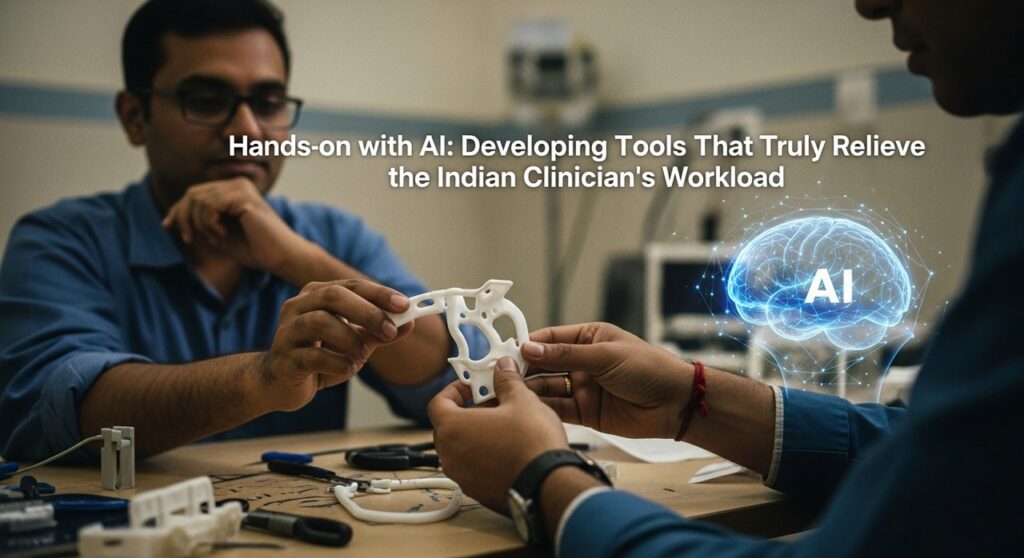
Hands-on with AI: Developing Tools That Truly Relieve the Indian Clinician’s Workload
On a sweltering afternoon in a bustling government hospital in Mumbai, Dr. Neha struggled to finish her rounds. She had 40 patients to see, a mountain of paperwork, and a phone that wouldn’t stop buzzing with follow-up queries. Her day, like for many clinicians across India, was a whirlwind of patient care, administrative tasks, and clinical decision-making. Amid this chaos, a question lingered: Could AI truly lighten this relentless workload?
India’s healthcare system is at a crossroads, grappling with a shortage of medical professionals, especially in rural and underserved areas. According to a report, India faces a shortfall of six million nurses globally, leaving clinicians overwhelmed with tasks that stretch them thin. Here, AI has the potential to transform healthcare delivery by automating repetitive tasks, enabling quicker diagnostics, and facilitating better patient management. Yet, the real question is: Are we building AI tools that genuinely relieve the clinician’s workload, or are they adding another layer of complexity?
The Promise of AI in Indian Healthcare
AI’s promise in healthcare is often couched in terms of efficiency and accuracy. Take Logi.AI, for example, which screened 4.5 million people for oral health conditions, flagging one in six for further treatment. This isn’t just a statistic, it’s a testament to AI’s capability to perform large-scale screenings that are otherwise impractical in resource-constrained settings. But are these tools designed with the clinician’s daily reality in mind?
AI can reduce diagnostic errors by up to 30%, according to a NITI Aayog report, but only if integrated thoughtfully into existing workflows.
In another instance, Chrogene Arogyam developed a non-invasive sickle cell anaemia screening device. By using AI to analyze how skin responds to temperature changes, it delivers rapid results, a boon in rural areas where laboratory facilities are scarce. Yet, the real impact lies in how these results are communicated and acted upon within the existing healthcare framework.
Concrete Steps for AI Integration
To genuinely alleviate the workload of clinicians, AI tools must be developed with an understanding of their working environment. Here are some steps to ensure AI solutions are not just innovative, but also practical:
- Understand the Workflow: AI solutions must be built around the clinician’s existing workflow, not the other way around. This means spending time in wards, identifying bottlenecks, and understanding daily pain points. For instance, if a tool can automate a part of the patient intake process, it should seamlessly integrate with existing hospital management systems without requiring extensive training or adjustments.
- Focus on Local Needs: Too many AI tools are designed with a one-size-fits-all approach. Indian hospitals have unique challenges, from resource constraints to diverse patient demographics. AI systems must be trained on Indian data sets and should accommodate regional languages and cultural nuances to be truly effective.
- Prioritize Simplicity and Usability: The best AI tools are those that require minimal effort to use. If a clinician has to spend more time learning a system than it saves, it’s a failure. Simple interfaces and clear, actionable outputs are essential. Take cues from CognitiveBiotics, whose autism communication platform is customizable and available in multiple languages.
- Ensure Robust Support and Training: Even the most intuitive tools require some level of training. Ongoing support, quick troubleshooting, and regular updates based on user feedback are crucial. Crafting affordable AI tools is only part of the solution; ensuring they are supported and effectively used is equally important.
- Measure Impact and Iterate: Once deployed, the impact of AI tools must be measured in terms of time saved, diagnostic accuracy, and patient outcomes. Regular feedback loops with healthcare workers can help refine these tools, making them more effective and tailored to real-world needs.
The Crucial Role of Collaboration
Collaboration between AI developers, clinicians, and regulatory bodies is essential to create tools that are not just innovative, but practical and compliant with local standards. As Sarvesh Singh from Telangana Life Sciences pointed out, indigenous models trained on Indian datasets offer immense opportunities for collaborative innovation.
For example, Garbha.ai‘s tool for infertility treatment leverages AI trained on local patient data to identify healthy embryos more accurately. This not only enhances clinical outcomes but also builds trust among healthcare providers who might be wary of foreign technologies.
Looking Beyond the Hype
It’s easy to get caught up in the hype surrounding AI in healthcare, but the reality is more nuanced. AI is not a panacea; it’s a tool, one that must be wielded with an understanding of the local context and clinician needs. As cost-effective prototyping has shown, innovation doesn’t require grand resources, just a clear understanding of the problem and a willingness to iterate.
In conclusion, the future of AI in Indian healthcare lies in its ability to integrate seamlessly into the clinician’s world, addressing real problems with practical, scalable solutions. Are we ready to listen to the needs of those on the front lines and build tools that truly make a difference? That’s the challenge, and the opportunity, that lies ahead.