
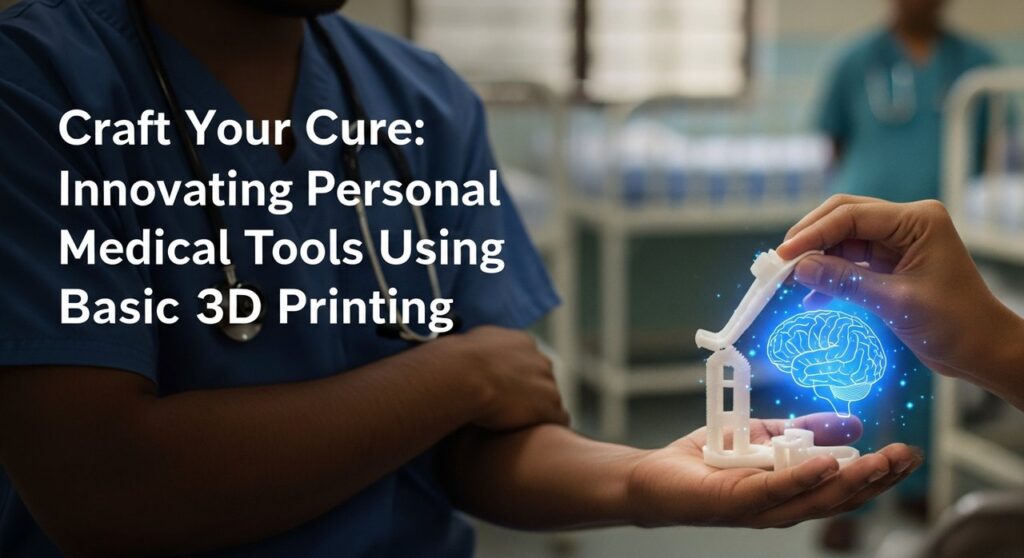
Craft Your Cure: Innovating Personal Medical Tools Using Basic 3D Printing
You’re in the middle of a bustling hospital ward, the needs are immediate, and the solutions seem just out of reach. A patient requires a personalized medical device, but the traditional path to production is too costly, too slow. This is the moment where 3D printing shines, a tool that can democratize innovation, cut through delays, and deliver tailor-made solutions in real time. But what’s the reality behind the promise?
The Old Guard vs. The New Wave
In the traditional manufacturing world, creating a medical device can be a labyrinth of red tape and exorbitant costs. Injection molding, for instance, requires expensive tooling and long lead times, making it impractical for customized, low-volume needs. It’s a system designed for mass production, not the tailored solutions increasingly needed in modern healthcare.
On the flip side, 3D printing offers a nimble alternative. Imagine being able to create a custom-fit splint directly in the hospital, tailored to a patient’s unique anatomy, within hours. The technology enables rapid prototyping and production without the need for specialized tooling. In essence, 3D printing turns the traditional model of manufacturing on its head, bringing it right into the clinical setting.
The real cost of sticking with traditional methods? Time, money, and potentially, patient outcomes.
The Mechanics of 3D Printing in Medicine
3D printing, or additive manufacturing, constructs objects layer-by-layer using materials like plastic, resin, or metal. In medicine, this technology has been a game-changer for creating patient-specific devices, from prosthetics to surgical instruments.
For instance, consider prototyping on a pediatric ward. Traditional methods would struggle with the complexity and customization needed for child-friendly medical devices. Yet, with a basic 3D printer, you can iterate designs rapidly, testing and refining until the perfect fit is achieved.
Cost and Access: Breaking Down Barriers
The upfront costs for 3D printing can be surprisingly low. Desktop 3D printers start at around INR 50,000 (approximately USD 600), with more sophisticated models reaching upwards of INR 300,000 (USD 3,600). Compare this to the millions often required for traditional manufacturing setups, and the financial barriers begin to crumble.
Moreover, the cost of materials is significantly lower when using 3D printing. Filament for FDM (Fused Deposition Modeling) printers, one of the most common types, costs roughly INR 1,000 per kilogram (USD 12), making it affordable for continuous prototyping and production.
By adopting 3D printing, you’re not just cutting costs; you’re gaining the freedom to innovate without financial handcuffs.
Practical Steps to Start 3D Printing in Your Practice
- Identify the Need: Before jumping in, pinpoint the clinical problem you’re aiming to solve. Use tools like AI to identify unmet clinical needs.
- Choose the Right Printer: For most medical applications, an SLA (Stereolithography) printer offers precision and high resolution, ideal for detailed medical devices.
- Design Your Solution: Use CAD software to create your design. If you’re new to this, start with simple, free software options like Tinkercad.
- Prototyping and Testing: Print your design and test it in a controlled setting. Iterate as necessary, refining the design based on real-world feedback.
- Regulatory Considerations: Familiarize yourself with the CDSCO guidelines for medical devices in India, ensuring compliance from the outset.
The Reality of Constraints
While the benefits are substantial, 3D printing in medicine isn’t without its hurdles. Sterility is a paramount concern; any device intended for use in sterile environments must meet rigorous standards. Additionally, regulatory approvals can be a complex maze, especially in the Indian context where guidelines are still evolving.
However, these challenges are not insurmountable. By partnering with experienced institutions or tapping into networks of innovators, you can navigate these waters effectively. Remember, innovation often thrives in environments that embrace constraints as opportunities for creativity.
The Path Forward: A Call to Arms
3D printing isn’t just a tool; it’s a movement that empowers you to craft solutions tailored to your patients’ needs. It’s about taking the initiative to transform ideas into tangible, life-improving devices. With the right mindset and resources, you can be at the forefront of this medical evolution.
So, are you ready to craft your cure? The tools are within your reach, waiting for your expertise to guide them into the future of personalized medicine.