
Transforming Ward Workflow: Quick, Practical Fixes You Can Implement Now
In the bustling corridors of Indian hospitals, the daily grind is palpable. Nurses dart from room to room, doctors juggle patient charts, and administrative staff scramble to keep up with endless paperwork. Amid this chaos, one might believe that only grand, costly solutions can bring respite. But what if I told you that the key to easing this burden lies not in grandiose plans, but in simple, practical tweaks you can implement immediately?
The Myth of Big Solutions
The prevailing notion is that to address workflow inefficiencies in healthcare settings, one needs extensive resources, high-tech solutions, and significant time investments. This belief is not only misleading but also paralyzing, leaving many clinicians and hospital administrators feeling helpless. The assumption that only large-scale interventions can effect change overlooks the power of small, targeted modifications that can collectively lead to substantial improvements.
Don’t let the myth of needing massive resources prevent you from making tangible improvements today.
The Reality: Small Changes, Big Impact
The truth is, transformative changes often start small. It’s about identifying pain points and tackling them with practical solutions that don’t require vast resources or time. Here, we’ll explore three key areas where immediate improvements can be made: communication, administrative efficiency, and patient engagement.
1. Streamlining Communication
Effective communication is the backbone of any healthcare facility. Yet, many hospitals still rely on outdated methods that hinder rather than help. Implementing a simple AI chatbot system, like the one recently launched at JJ Hospital in partnership with BeyondChats, can significantly enhance communication efficiency. This tool can handle common queries, assist in patient interactions, and streamline administrative tasks, freeing up valuable time for staff.
- Identify repetitive communication tasks: Look for tasks that consume time and can be automated, such as appointment reminders and FAQs.
- Implement AI solutions: Use chatbots to handle these repetitive tasks, ensuring seamless integration with existing hospital systems.
- Monitor and adjust: Regularly assess the chatbot’s performance and make necessary adjustments to enhance its efficiency.
By leveraging AI, hospitals can reduce the communication burden on staff, allowing them to focus on more critical tasks that require human intervention.
2. Enhancing Administrative Efficiency
Administrative tasks often bog down healthcare providers, consuming time that could be better spent on patient care. Automating appointment scheduling, billing, and patient intake forms can significantly reduce these burdens. Tools like online appointment scheduling systems are a great starting point.
- Evaluate current processes: Identify administrative tasks that are time-intensive and prone to errors.
- Adopt digital solutions: Implement electronic health record (EHR) systems and online scheduling tools to streamline these processes.
- Train staff: Ensure all staff members are trained to use these digital tools effectively to maximize their benefits.
These changes not only improve efficiency but also minimize the potential for human error, leading to better patient outcomes.
3. Empowering Patients with Self-Service Tools
Modern patients expect a seamless digital experience, akin to online shopping. By providing self-service tools, such as digital patient intake forms and online portals for test results, hospitals can enhance patient satisfaction and reduce workload on staff.
- Identify patient needs: Understand what digital services patients value most, such as online appointment booking or access to medical records.
- Implement self-service platforms: Deploy user-friendly portals that allow patients to manage their healthcare at their convenience.
- Promote and educate: Encourage patients to use these tools by educating them about the benefits and ease of use.
Empowering patients to manage certain aspects of their care not only enhances their experience but also alleviates pressure on healthcare providers.
Making It Happen: The Scrappy Path
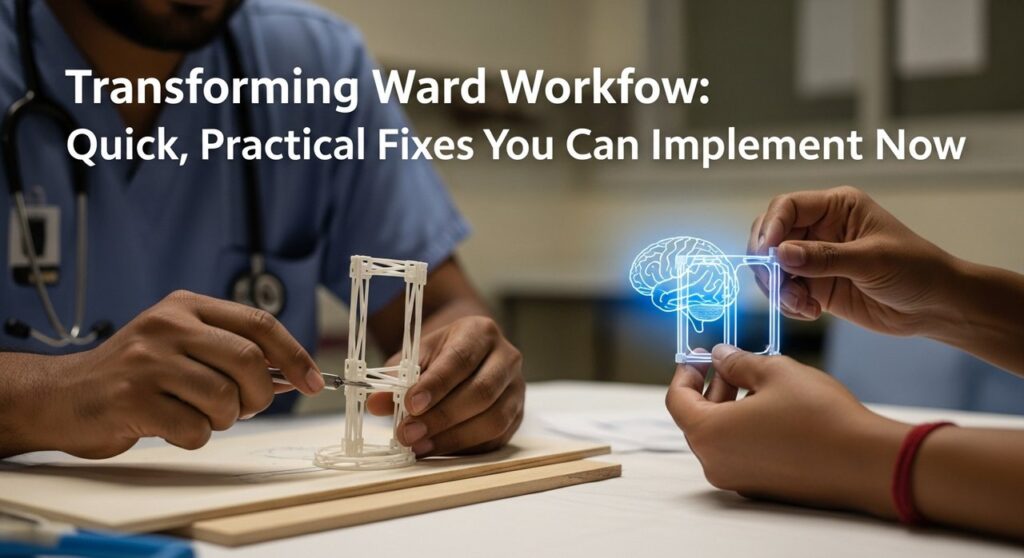
Innovation doesn’t require an engineering degree or a grant. It demands a keen eye for identifying problems and a willingness to experiment with solutions. At MICE Labs, we champion the scrappy path, where clinicians and medical students turn real bedside problems into practical solutions. Whether it’s through prototyping quick solutions or upcycling materials for medical use, the path to innovation is more accessible than you might think.
Start by observing your ward. What are the daily irritants? Which processes seem unnecessarily cumbersome? Begin by addressing these small issues. Often, the solution is as simple as repurposing existing tools or rethinking a process. The key is to take action and not be daunted by the scale of the problem.
Conclusion: A Call to Action
The belief that only large-scale interventions can transform healthcare workflows is a myth that needs dismantling. Real, impactful improvements are within reach through small, strategic changes in communication, administration, and patient engagement. By embracing the scrappy path and leveraging available tools, even resource-constrained environments can achieve remarkable results.
So, what are you waiting for? Take a fresh look at your ward, identify those pesky pain points, and start implementing changes today. The road to a more efficient healthcare system begins with you.