
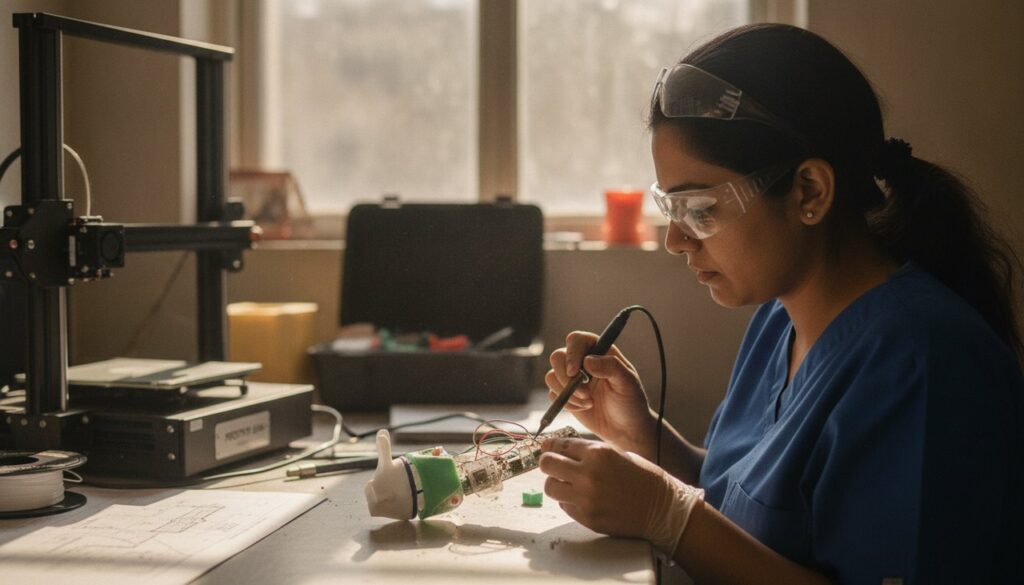
Transforming Time-Consuming Tasks: Prototyping Quick Solutions You Can Implement
It was 3 AM when Dr. Mehta realized the IV drip failure wasn’t an isolated incident. For the third time that night, he had to improvise a solution to prevent the drip from dislodging during patient movement. Frustration mounted as he wondered why no one had yet designed a simple fix for such a common problem. But this thought sparked an idea, what if he could prototype a solution himself? This was the moment that transformed Dr. Mehta from a clinician into an innovator.
In the chaotic environment of Indian hospitals, where resources are stretched thin, the opportunity to prototype quick, effective solutions is more than just a luxury, it’s a necessity. But where does one start? How can clinicians, who are not traditionally trained as engineers, begin to prototype solutions for the challenges they face daily? The path isn’t as complex as it might seem, and with the right approach, anyone can become a problem-solver.
Understanding the Prototyping Mindset
Prototyping isn’t about crafting the perfect product on the first try. It’s a process of trial and error, where failures are stepping stones to success. The goal is to quickly create a tangible version of your idea, test it, learn from it, and iterate. This mindset shift is crucial for clinicians who are used to precision and correctness in their work.
“Fail fast, learn faster.” This principle underpins effective prototyping. Embrace it.
Step-by-Step: From Problem to Prototype
Let’s break down the prototyping process into actionable steps that can be implemented even in resource-constrained settings.
- Identify the Problem: Start with a specific, recurring issue you encounter. The more precise your understanding, the better your solution will be. For instance, if you’re dealing with faulty IV drips, define exactly what goes wrong and under what conditions.
- Sketch a Solution: You don’t need advanced software; a simple pencil and paper will do. Visualize your idea. For instance, Dr. Mehta drew a clip-on support for the IV line that could be easily adjusted for patient movement.
- Select Materials: Choose based on availability and functionality. Cardboard, plastic, or even repurposed medical materials can work for initial prototypes. For more on material selection, consider this guide on affordable storage solutions.
- Build the Prototype: Create a basic model of your solution. Use common tools like scissors, glue, or tape. The goal is to see if your idea holds up in practice.
- Test and Iterate: Try the prototype in its intended environment. Gather feedback, observe its functionality, and refine it. This step is crucial and often takes multiple iterations to get right.
Overcoming Common Barriers
Clinicians face unique challenges when prototyping, including sterility and regulatory constraints. However, these can be navigated with the right strategies.
1. Sterility Concerns
Medical devices must adhere to strict sterility standards. While prototyping, use materials that can be easily sterilized or are inherently sterile. For tips, check out our article on safe device prototyping.
2. Regulatory Hurdles
Understanding the CDSCO guidelines is essential for moving from prototype to product. Begin with a clear understanding of these regulations, and consider partnering with local institutions that can provide guidance.
3. Resource Constraints
Innovating within a tight budget is challenging but not impossible. Utilize low-cost materials and consider 3D printing for more complex designs. The advent of desktop 3D printers has democratized access to rapid prototyping, making it affordable and feasible for individual innovators.
Prototyping is not about resources; it’s about resourcefulness.
The Power of Local Context
Prototyping in India’s medical environment requires an understanding of local patient needs and hospital conditions. Solutions must be affordable, durable, and easy to use. For instance, a pediatric ward might benefit from child-friendly medical devices that are not only functional but also non-threatening to young patients.
Furthermore, engaging with local manufacturing units can accelerate the prototyping process. They offer insights into material availability and production techniques that are cost-effective within the Indian context.
Beyond Prototyping: Innovator to Entrepreneur
Once you’ve developed a working prototype, the next step is validation and scaling. This transition from innovator to entrepreneur involves understanding the broader market needs and potential scalability of your solution. Consider forming partnerships with institutions for pilot testing and gathering real-world data to support your product’s efficacy.
Remember, the path from prototype to product is not linear. It requires perseverance, adaptability, and a willingness to learn from each step. Dr. Mehta’s journey from a frustrated clinician to a pioneering innovator is a testament to what can be achieved with determination and the right mindset.
Conclusion: The Innovator’s Imperative
In an environment where time and resources are perpetually constrained, the ability to rapidly prototype solutions is a powerful skill. It transforms passive frustration into active problem-solving. Clinicians are uniquely positioned to identify and address inefficiencies in their work environments, and with the right approach, they can become the architects of meaningful change.
So, the next time you encounter a ward challenge, remember Dr. Mehta. The solution might just be a prototype away. The question is, are you ready to take the first step?