
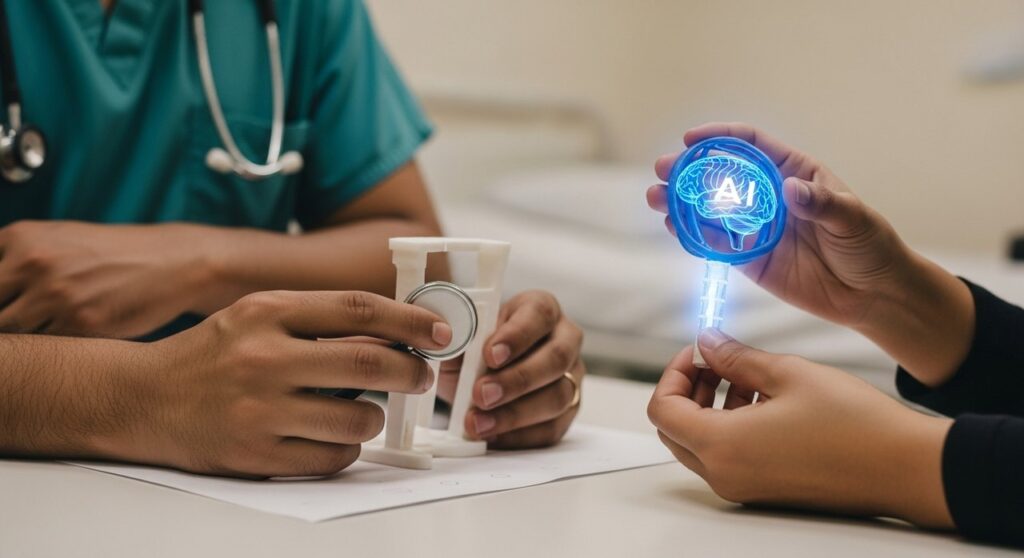
From Stethoscope to Smart Scope: Building Simple Diagnostic Enhancements You Can Test
Picture this: You’re in a bustling ward, a stethoscope slung around your neck, but you’re not hearing what you need. The analogue tool in your hands feels like a relic in this age of digital transformation. This is not just your imagination, it’s a common frustration for many clinicians who feel the limitations of traditional tools. But fear not, because the bridge from old to new is shorter than you think.
The Myth of Complexity
There’s a widely held belief that upgrading diagnostic tools from analogue to digital is a complex, expensive, and highly technical endeavor. Many clinicians assume that only tech giants or those with engineering degrees can innovate in this space. This belief not only stymies innovation but also perpetuates the use of outdated methods that may not be serving patients as effectively as possible.
However, the reality is different. With a bit of guidance and the right mindset, you can enhance your diagnostic tools without needing a degree in engineering or enormous funding. A stethoscope isn’t just a symbol of medical practice; it’s a starting point for innovation.
Breaking Down the Reality
So, what does this innovation look like? Let’s take the stethoscope, a device used by clinicians worldwide for auscultation. While the traditional stethoscope amplifies chest sounds through mechanical vibration, digital enhancements can provide clearer, more accurate data that can be stored, analyzed, and even shared remotely.
Digital stethoscopes, for instance, are equipped with microphones and sensors that convert sound waves into digital data. This data can be processed to filter out noise and focus on specific frequencies, making it easier to diagnose conditions that analogue stethoscopes might miss. Furthermore, these devices can integrate with smartphone apps, providing visual representations of the sounds and enabling telemedicine capabilities.
Digital stethoscopes can amplify sounds up to 60 times more than traditional ones, providing clearer insights for diagnosis.
Steps to Build and Test Your Enhancements
- Start with What You Know: Identify the specific limitations in your current device. Is it sound quality, data storage, or the ability to share findings remotely? Knowing your baseline is crucial.
- Gather Basic Materials: You don’t need advanced components to start. A MEMS microphone, a basic ADC (Analog-to-Digital Converter), and some audio recording software can be acquired for under INR 5,000.
- Build a Simple Prototype: Connect the microphone to the ADC and link it to a laptop or smartphone. Use open-source software to visualize sound waves and refine your design based on initial tests.
- Iterate Based on Feedback: Test your prototype in real-world conditions. Gather feedback from colleagues and adjust your design to address any shortcomings. This step is crucial and can save time and resources in the long run.
- Consider Regulatory Requirements: Understand the CDSCO regulations for medical devices in India. While your initial prototype may not need approval, understanding the path to compliance is essential for future development.
Of these steps, gathering feedback and iterating is the most important. No prototype is perfect on the first try. Listening to real-world feedback ensures that your enhancements are practical and truly address the needs of your clinical setting.
Facing the Challenges
While the path to innovation is accessible, it is not without challenges. Cost and accessibility remain concerns, especially in resource-limited settings. However, leveraging local manufacturing and understanding the unique needs of Indian healthcare can mitigate these issues.
Furthermore, clinician training and data privacy are hurdles that need addressing. As with any new technology, ensuring that all users are comfortable and competent in utilizing the new tool is essential. Data collected by digital devices must be stored securely to comply with privacy regulations.
Building Sustainable Innovations
By understanding and leveraging the unique advantages of digital enhancements, clinicians can transform simple diagnostic tools into powerful aids in patient care. It’s about taking small, manageable steps toward building something that fits within your clinical context.
Innovation doesn’t require perfection; it requires progress. Each step you take towards enhancing your tools is a step towards better patient care.
For those ready to take the plunge, resources are available. Check out our guide on building solutions you can test this week for practical advice on getting started. You can also explore how simple hacks to everyday tools like the stethoscope can have a significant impact.
The Provocation
As you stand in the ward, with patients in need of accurate, timely diagnoses, consider this: What could you build this week that bridges the gap between your expertise and the tools at your disposal? The power to innovate is in your hands, and the journey from stethoscope to smart scope is a path worth taking.