
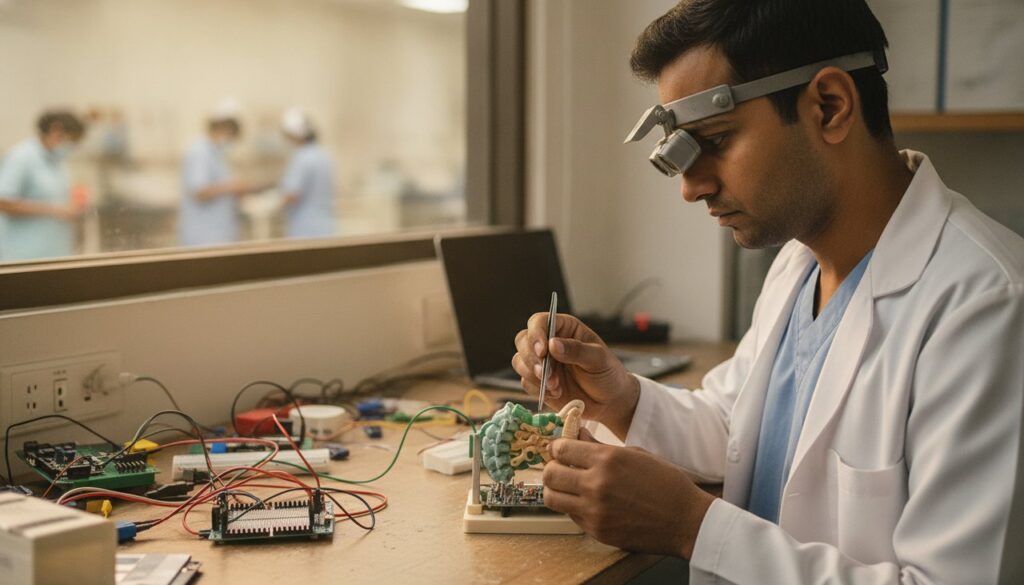
AI for Indian Clinicians: Crafting Decision-Support Tools with Everyday Tools
Step into a typical government hospital in India, and you’ll quickly see that time is a scarce resource. A junior doctor, juggling multiple patients, tries to decipher a complex case while simultaneously managing the relentless stream of administrative tasks. In such an environment, the promise of AI-powered decision-support tools is not just a luxury, it’s a necessity. But here’s the kicker: you don’t need an elaborate setup or an engineering degree to start crafting these tools. Armed with everyday technology and a clear understanding of your clinical challenges, you can begin to make a significant impact.
The Comfortable Myth: AI is for the Tech-Savvy Only
There’s a prevalent myth that AI applications in healthcare require a deep technical background, substantial funding, and advanced infrastructure. This belief often discourages clinicians from exploring AI’s potential, especially in resource-constrained settings like many Indian hospitals. The reality, however, is starkly different.
AI tools are not the exclusive domain of tech giants or well-funded labs. With the right approach, clinicians can harness these technologies using accessible resources.
Reality Check: AI with Everyday Tools
Consider the story of Dr. Mehta, a physician at a busy government hospital in Mumbai. Faced with the challenge of managing an overwhelming influx of patients during the COVID-19 pandemic, Dr. Mehta explored AI solutions to optimize patient triage. With no formal training in AI, he turned to freely available platforms and open-source tools.
Using a basic laptop and Python, an open-source programming language, Dr. Mehta developed a simple machine learning model to prioritize patients based on symptom severity. This model used historical patient data and was integrated into the hospital’s existing workflow without any major infrastructural changes.
Steps to Craft AI Tools in Resource-Constrained Settings
- Identify the Problem: Start by pinpointing a specific clinical challenge. Whether it’s streamlining patient triage or enhancing diagnostic accuracy, clarity on the problem is crucial.
- Leverage Open-Source Tools: Platforms like TensorFlow and PyTorch offer powerful machine learning libraries that are freely available. They come with extensive documentation, making them accessible even to those without a technical background.
- Use Existing Data: Most hospitals already collect vast amounts of data. Use this existing resource as the foundation for your AI models. Remember, data quality is more critical than quantity.
- Prototype with Simplicity: Start small. Develop a basic prototype that can be tested and iterated upon. This approach not only reduces complexity but also allows for quick feedback and adjustments.
- Collaborate and Share: Engage with peers, join forums, and participate in workshops. Sharing your journey and learning from others can accelerate development and improve outcomes.
The Most Crucial Step: Start Small, Think Big
The most critical step in this journey is to start small. It might sound counterintuitive, but beginning with a manageable project allows you to navigate challenges and learn without being overwhelmed. It’s the small victories that build confidence and pave the way for larger, more ambitious projects.
Dr. Mehta’s initial model was far from perfect. However, by starting small, he was able to refine his approach, gather support from colleagues, and eventually scale the solution hospital-wide. The result? A more efficient triage process that saved time and improved patient outcomes.
The Path Forward: Encouragement with Teeth
Indian clinicians are uniquely positioned to drive AI innovation in healthcare. The constraints of our environment, limited resources, high patient volumes, and diverse clinical challenges, are not hindrances but catalysts for creativity and innovation.
By embracing the scrappy path, clinicians can craft AI tools that are not only relevant to their context but also transformative for their practice. The question is not whether you can build these tools but how quickly you can start.
For those ready to embark on this journey, remember: the road is challenging, but the rewards are significant. Begin with what you have, learn as you go, and let the needs of your patients guide your innovations. With AI, the potential to enhance clinical practice and patient care is immense, and it starts with you.
For more guidance on crafting AI tools in resource-constrained settings, explore our detailed guide on Crafting Affordable AI Tools in the Constraints of Indian Hospitals.