
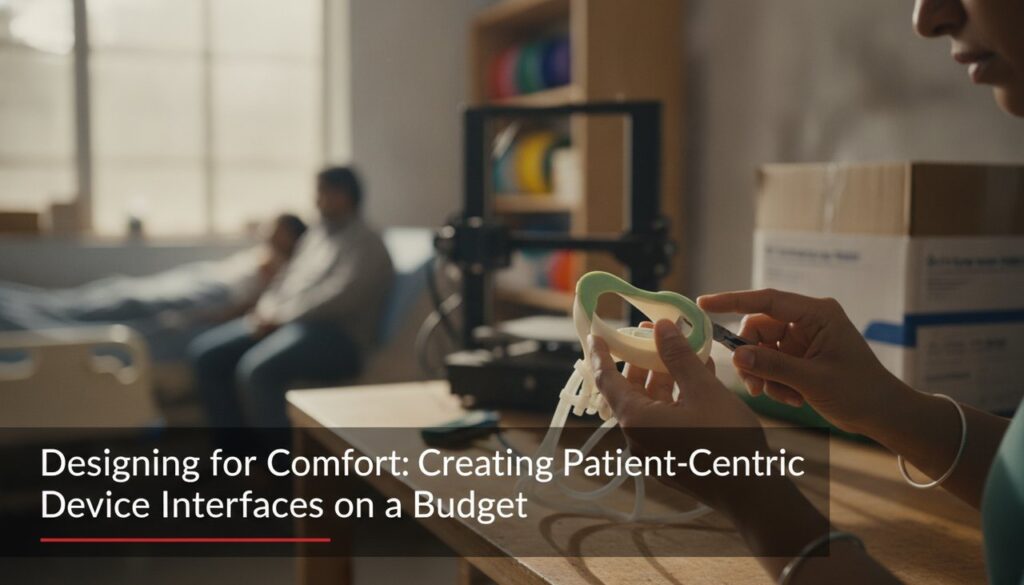
Designing for Comfort: Creating Patient-Centric Device Interfaces on a Budget
Standing in the crowded corridors of a government hospital in Mumbai, a young resident watches as a patient struggles to use a device meant to ease their condition. The device, though effective in theory, is anything but in practice. This scene is not an isolated incident but a recurring theme across healthcare settings, particularly in resource-constrained environments. The idea of patient-centric device design often conjures images of high-end, expensive solutions, but what if the real innovation lies in simplicity and affordability?
The Illusion of Complexity vs. The Elegance of Simplicity
In the world of medical device design, there’s a persistent myth: complexity equals quality. Yet, this assumption is increasingly proving to be a costly mistake, particularly when designing for patient comfort and usability. It’s not about how many features a device has, but how effectively it can integrate into a patient’s life without overwhelming them.
“Complexity doesn’t equate to efficacy. In fact, it often hinders usability and patient adherence.”
Consider the contrast between complex multi-functional devices and more straightforward, user-friendly options. Complex devices, while technologically advanced, often require extensive training, are intimidating, and can lead to user error. On the other hand, simplicity fosters confidence, encouraging consistent use which is crucial for therapeutic outcomes.
Steps to Achieve Patient-Centricity on a Budget
1. Engage with Real Users
There’s no substitute for real-world feedback. Engaging with users early in the design process can provide invaluable insights into what works and what doesn’t. A simple patient feedback loop can often lead to the most groundbreaking innovations. This step is less about cost and more about commitment to user-centricity.
2. Prioritize Essential Features
More isn’t always better. Focus on the core functionalities that address the primary needs of patients. This not only reduces costs but also streamlines the design process, allowing for quicker iterations and testing. The goal is to remove any friction in the user experience.
3. Leverage Local Resources
In the Indian context, accessing local materials and manufacturing capabilities can significantly cut costs. Collaborating with local craftsmen or small-scale manufacturers can offer affordable solutions without compromising on quality. This approach also ensures that the device is culturally and contextually appropriate.
4. Implement Iterative Prototyping
Prototyping doesn’t have to break the bank. Utilizing low-cost materials for initial prototypes allows for rapid iteration and testing. This process can highlight usability issues early, enabling designers to refine the interface before scaling up production.
5. Embrace Open-Source Solutions
The open-source community offers a plethora of resources that can be adapted for medical device design. From software to hardware components, these resources can provide a solid foundation that saves both time and money.
The Counter-Intuitive Truth: Simplicity as a Cost-Saver
It’s easy to fall into the trap of believing that a higher budget guarantees a better product. However, the reality is often the opposite. Complex devices not only cost more to develop and manufacture but also demand more from the user, leading to lower adherence and effectiveness. By focusing on simplicity, the design process becomes more agile and cost-effective, ultimately leading to a product that resonates with its users.
Take, for example, Mumbai’s surgical innovators, who have demonstrated that patient-friendly devices don’t need to be complex to be effective. By prioritizing user needs and context, they have crafted solutions that are both affordable and practical.
Real-World Applications and Success Stories
Consider the development of a simple splint designed for ease of use in rural clinics. By focusing on ergonomics and using locally available materials, designers were able to create a product that was both effective and affordable. This splint is now widely used in various clinics, proving that simplicity doesn’t just save money; it transforms care.
Similarly, a portable solution for remote patient monitoring was developed using a simple interface, allowing patients to easily track their health metrics without needing extensive training. The success of these devices underscores the power of simplicity in design.
Conclusion: A Challenge to Designers
Designing for comfort is not a luxury but a necessity, especially in resource-constrained settings. The challenge lies in breaking free from the allure of complexity and embracing the elegance of simplicity. Patient-centric design on a budget is not only possible but essential for the future of healthcare innovation. As you embark on your next design project, consider this: what can you subtract to add value?