
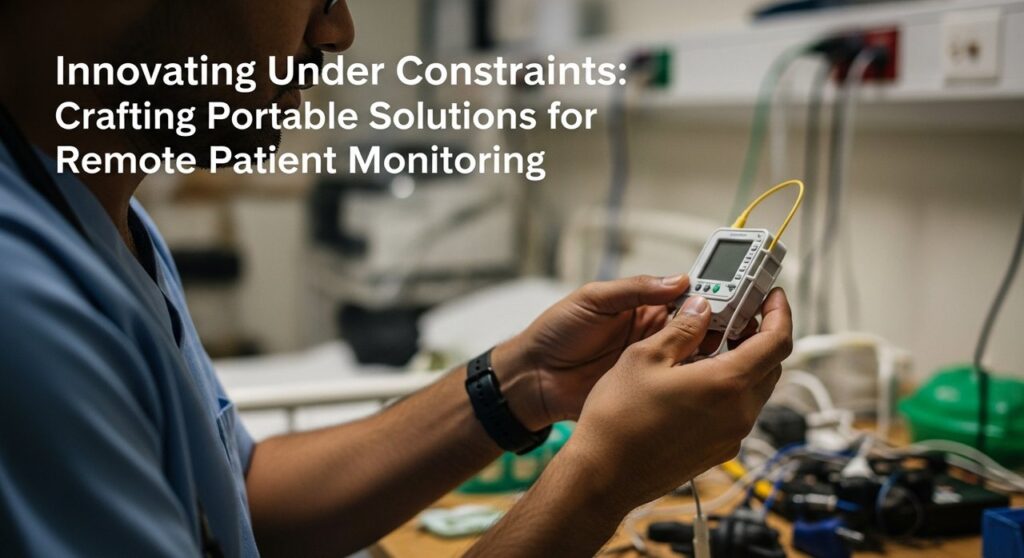
Innovating Under Constraints: Crafting Portable Solutions for Remote Patient Monitoring
In a bustling government hospital ward in Mumbai, the loud beeping of machines, the hurried footsteps of nurses, and the constant chatter of patients and their families create an overwhelming atmosphere. Amidst this chaos, Dr. Rao, a young resident, grapples with a challenge that’s now all too common: monitoring her patients’ vitals remotely while ensuring she doesn’t miss a critical deterioration. What if she could keep a watchful eye on her patients even when she’s not physically present, especially those in rural areas? This is the promise, and the challenge, of remote patient monitoring (RPM) in India.
The Two Paths: Conventional vs. Contextual Innovation
Traditionally, RPM systems have relied on expensive imported technologies with hefty price tags and complex infrastructures. These solutions, while technologically advanced, often feel out of reach for many Indian hospitals due to cost and logistical constraints. Dr. Rao’s hospital, like many others, operates on tight budgets, where every rupee saved can be redirected to patient care.
On the other side of the spectrum, there’s a burgeoning interest in crafting contextually relevant solutions, innovations born from the very constraints that challenge them. Imagine creating RPM solutions using locally available materials, designed to function effectively within the existing limitations of Indian healthcare environments.
“Constraints are not barriers; they are invitations to innovate.”
Building a Portable Solution: The Vitaliti™ Case Study
The Vitaliti™ Continuous Patient Monitoring (CPM) wearable system, developed by Cloud DX, is a perfect example of innovation under constraints. It integrates seamlessly with remote monitoring systems to provide a comprehensive solution. The device is designed to monitor five critical vital signs, blood pressure, heart rate, body temperature, blood oxygen saturation, and respiratory rate, in real-time, using a single, streamlined device.
Here’s the twist: the Vitaliti™ system is not just another high-tech gadget. It’s a practical response to the specific needs of Indian healthcare providers. The device is built to be cost-effective, durable, and easy to use, addressing the challenges of data accuracy and secure transmission without requiring extensive infrastructure.
Designing for Usability and Accessibility
The core of effective RPM lies not just in data collection but, crucially, in its visualization. Traditional data representations like charts and tables often fall short in conveying complex information intuitively. The RemoteHealthConnect system tackles this by offering custom visualizations that promote pattern recognition and anomaly detection, enhancing clinician performance regardless of the patient’s location.
A usability study revealed the system’s capacity to transform complex bedside data into accessible visualizations, making it easier for healthcare practitioners to make informed decisions quickly. The system scored 71.5 on the System Usability Scale (SUS), positioning it above the average for healthcare technologies. This is not just a technical achievement but a breakthrough in making high-quality care accessible in remote areas, where such tools are most needed.
Tackling Real-World Challenges
Despite the promise of RPM systems like Vitaliti™, several challenges remain. In the Indian context, issues such as patient affordability, regulatory approvals, and local manufacturing constraints are significant hurdles. For instance, ensuring sterility in devices that need to be reused across different patients is a critical concern that MICE Labs addresses in their programs.
Moreover, the lack of reliable internet connectivity in rural areas can hinder real-time data transmission, a problem that requires innovative solutions such as offline data synchronization features or low-bandwidth optimization.
“The real innovation lies in transforming limitations into leverage.”
The Path Forward: Scrappy Innovation
For Dr. Rao and her peers, the journey from problem to prototype doesn’t require an engineering degree or a massive grant. It requires a scrappy, resourceful approach, leveraging local materials, understanding the specific needs of Indian patients, and navigating the regulatory landscape with ingenuity.
By adopting a mentor-maker mindset, young clinicians can drive change. Programs like PULSE, MEDIC, and MEDHA, offered by MICE Labs, empower them to turn bedside frustrations into fabrications, creating low-cost, effective solutions that fit the unique challenges of Indian hospitals.
The key is to challenge the status quo and view constraints not as obstacles but as opportunities for innovation. This shift in perspective is what will ultimately drive the next wave of breakthroughs in remote patient monitoring, making high-quality healthcare accessible to all, regardless of location or economic status.
Conclusion: Rethinking Constraints as Catalysts
As Dr. Rao reflects on the bustling ward, she realizes the power of reimagining constraints as catalysts for innovation. By embracing the limitations and leveraging them to drive creative solutions, healthcare providers can craft RPM systems that are not only effective but also accessible and sustainable.
The true revolution in healthcare will come not from the most advanced technologies but from the simplest solutions that are deeply rooted in the realities of the environments they serve. For India, this means crafting portable solutions that cater to its diverse needs, ensuring that no patient, regardless of where they are, is left behind. The question isn’t whether constraints can be overcome, it’s how they can be transformed into the very foundation of innovation.