
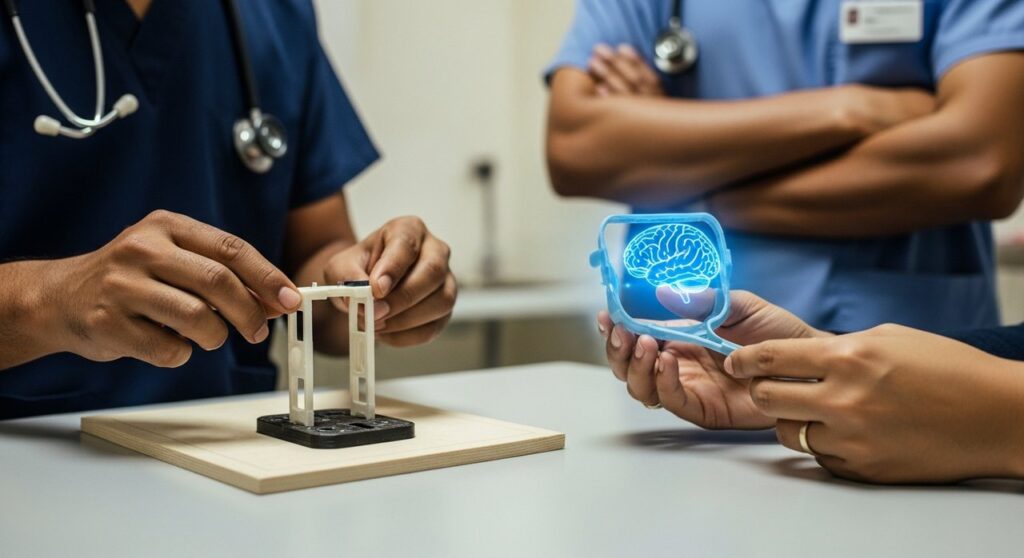
Engineering a Seamless Shift: Optimizing Handovers with Simple Tech
Imagine you’re in a bustling government hospital in Mumbai, managing a ward with minimal resources. The day is a blur of patient rounds, urgent calls, and the hum of machines. Suddenly, a critical patient needs immediate transfer to a specialized department. It’s a situation that requires seamless communication and rapid handover, yet technology often feels like a barrier instead of a bridge. But what if the right, simple tech could change that? What if we could strip away the complexity and find a path to truly effective handovers?
The Reality of Handover Chaos
In many Indian hospitals, handovers can be chaotic. Each shift change is a potential minefield, where critical patient information might slip through the cracks. A study by an Indian healthcare institute revealed that handover miscommunications accounted for nearly 30% of clinical errors. This isn’t just a statistic, it’s a real cost in lives and trust. Imagine missing a crucial update about a patient’s allergy or medication change because it was scribbled on a paper that got misplaced. This is the reality many clinicians face every day.
“A study by an Indian healthcare institute revealed that handover miscommunications accounted for nearly 30% of clinical errors.”
The Assumption: Complex Tech Equals Better Solutions
It’s easy to fall into the trap of believing that complex technology is the answer to our problems. Many assume that sophisticated systems, layered with features, are the best way to ensure effective communication. But this isn’t always true. In fact, complexity often breeds confusion. The more complicated a system, the more training it requires, and the harder it becomes to use under pressure. This is a reality in many resource-strapped hospitals where time and training are luxuries that few can afford.
The Simpler Path: Leveraging Accessible Technology
Contrary to popular belief, the solution to improving handovers doesn’t lie in adding layers of complexity but in simplifying processes. Here’s how you can start:
- Utilize Simple Digital Tools: Adopt straightforward digital tools that can be used intuitively. Mobile apps designed for note-taking or quick audio recordings can capture critical information swiftly. These tools don’t require extensive training or resources, making them ideal for busy hospital environments.
- Create Standardized Templates: Develop standardized digital templates for handovers. This ensures that all necessary information is captured consistently. Templates can be shared easily across mobile devices, ensuring accessibility and uniformity.
- Encourage Real-Time Updates: Implement systems that allow for real-time updates. Simple cloud-based platforms can enable clinicians to update patient information on the fly, ensuring that incoming staff have the latest data.
- Leverage Audio-Visual Aids: Sometimes, a picture or a voice note can convey more than text. Use cameras on mobile devices to capture visuals of critical charts or patient conditions. Audio notes can also provide context that written words might miss.
Focus on What Matters Most: Real-Time Communication
Among these steps, real-time communication stands out as the most crucial. It’s the key to ensuring that nothing gets lost in translation during handovers. A tool that supports live updates, whether through a simple messaging app or a dedicated healthcare platform, can transform how information is shared. This shift towards immediacy and clarity in communication can significantly reduce the risk of errors.
Case Study: A Simple Yet Effective Transformation
Consider the case of a resource-strapped hospital in Kerala that was struggling with handover inefficiencies. By implementing a basic cloud-based note-sharing system, the hospital reduced its handover-related errors by 40% within six months. This system required no more than a smartphone and internet access, demonstrating that simplicity, not sophistication, drives improvement.
Breaking the Myth: You Don’t Need an Engineering Degree
One common myth is that you need an engineering degree or a large budget to implement tech solutions in healthcare. This couldn’t be further from the truth. As demonstrated by the Kerala hospital, the right approach is about creativity and practicality, not technical prowess. In fact, many solutions can be developed and implemented by clinicians themselves, leveraging their deep understanding of workflow needs.
Embrace the Scrappy Path
In the world of clinical innovation, necessity is often the mother of invention. You don’t need to wait for a grant or permission to start improving handovers. Begin by identifying the specific pain points in your current process. Is it the inconsistency of information? The delay in updates? Once you pinpoint the issue, look for the simplest tech that can address it. Remember, the goal is to enhance communication and efficiency, not to complicate it.
FAQs
Why focus on simple technology for handovers?
Simple technology is easy to implement, requires less training, and is often more affordable. It allows for quick adoption and immediate impact, especially in environments with limited resources.
How can I implement these changes in my hospital?
Start by assessing your current handover process to identify gaps. Choose one or two simple digital tools that address these gaps and pilot them in a controlled setting to evaluate their effectiveness.
What if our hospital has no budget for tech solutions?
Look for free or low-cost apps that can be used on existing devices. Many effective solutions require nothing more than a smartphone or computer, making them accessible even in budget-constrained environments.
In conclusion, the path to optimizing handovers isn’t about adding layers of complex technology. It’s about cutting through the noise and finding simple, practical solutions that improve communication and efficiency. By focusing on real-time updates and leveraging accessible tools, we can transform the way information is handed over in hospitals, improving patient care and reducing errors. It’s time to embrace simplicity and make a real difference where it counts.