
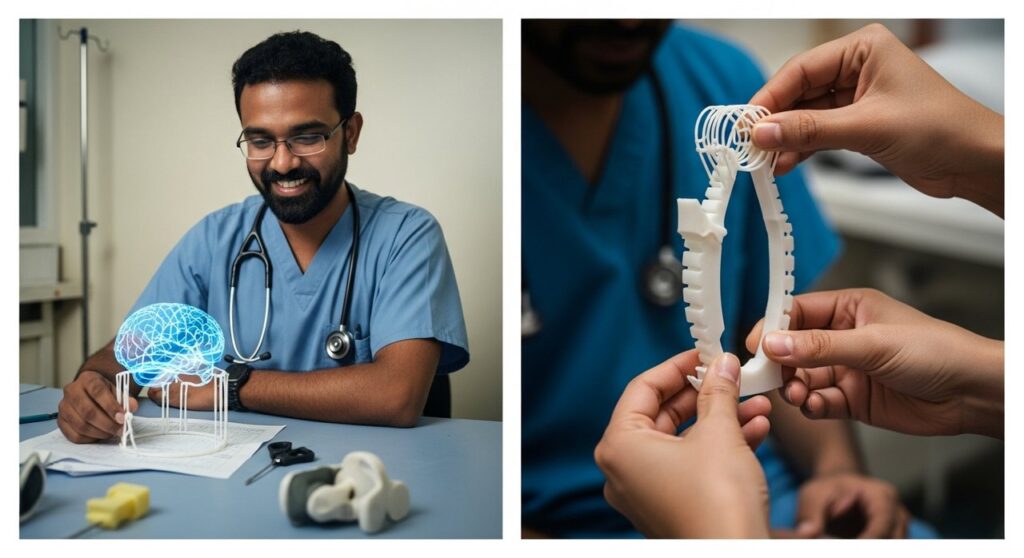
How a Mumbai Resident Built a Low-Cost Surgical Splint from Scratch
In the bustling wards of Mumbai’s public hospitals, where resources are perpetually stretched thin, necessity often births innovation. One such story begins not with a high-tech lab or a government grant, but with a simple question: how can we make a better splint?
Meet Dr. Aarti, a surgical resident at Sir J.J. Hospital, who, while managing an overwhelming number of trauma cases, encountered a recurring issue. The standard plaster of Paris (POP) splints, though effective, were far from efficient in her setting. They were cumbersome, costly, and couldn’t be reused. Patients often needed reassessment, leading to the removal and reapplication of these splints, a process that was both time-consuming and resource-intensive.
The Problem with Conventional Splints
In a typical day, Dr. Aarti might assess up to 30 new trauma referrals, many requiring immobilization with a volar resting slab. The conventional POP splinting method involved wrapping wool around the limb, applying wet plaster, and securing it with a crepe bandage. While this method worked, it was not without its flaws.
- Costly and Wasteful: Each splint required new materials, escalating costs and generating waste.
- Time-Consuming: The removal and reapplication of splints for reassessment or post-operative checks were inefficient.
- Patient Discomfort: The process of removing the splint often caused discomfort and anxiety among patients.
This inefficiency was not just a logistical challenge but a drain on already limited resources. Dr. Aarti knew there had to be a better way.
The Solution: A Reusable, Low-Cost Splint
Driven by the need for a practical solution, Dr. Aarti set out to create a reusable splint using readily available materials. Her goal was to develop a splint that was not only cost-effective but also easy to apply, remove, and reapply without compromising on patient comfort or immobilization quality.
- Materials: Dr. Aarti sourced materials directly from the hospital’s existing supplies. She used a stockinette to encase the POP, preventing it from sticking to the wool, thereby making the cast reusable.
- Design: The splint was designed to be aesthetically pleasing and functional. The stockinette kept the POP confined, giving it a neat appearance.
- Application: The process was straightforward. Cut the required length of plaster, soak it, and slide it into the stockinette. Lay it flat to even out the plaster, fold the edges of the stockinette inward, and apply wool padding over the top. Secure the splint to the arm with a bandage and tape, molding it as required.
This method is not just about innovation; it’s about adapting to real-world constraints. The splint can be removed and reapplied with ease, saving both time and materials.
Dr. Aarti’s splint design wasn’t just a theoretical improvement; it was a practical solution tailored to the unique challenges of her environment. By using a simple stockinette, she transformed a once-disposable piece of medical equipment into a reusable asset.
Impact and Implications
The implications of Dr. Aarti’s innovation extend beyond the hospital floor. By reducing the need for multiple POPs, the hospital could save significant costs, which could then be redirected towards other critical needs. More importantly, it empowered residents and clinicians to think creatively about problem-solving within their constraints.
| Aspect | Conventional Splint | Reusable Splint |
|---|---|---|
| Cost | High (Non-reusable) | Low (Reusable) |
| Time Efficiency | Low (Time-consuming) | High (Quick application) |
| Patient Comfort | Moderate | High |
This innovation challenges the common belief that medical advancements require high-tech solutions or substantial funding. It demonstrates that practical, impactful changes can originate from within the system by those who understand it best.
Lessons for Aspiring Innovators
Dr. Aarti’s journey offers several lessons for aspiring medical innovators:
- Identify Real Needs: Innovation should start with a clear understanding of the problem. Dr. Aarti’s initiative was driven by firsthand experience with inefficiencies in her daily work.
- Use Available Resources: Instead of waiting for external funding or resources, leverage what’s available. Creativity can often overcome resource constraints.
- Iterate and Improve: The first design is rarely perfect. Be open to feedback and ready to iterate on your solutions to optimize them further.
For those looking to follow in Dr. Aarti’s footsteps, remember that innovation doesn’t require an engineering degree or a significant grant. It requires a keen eye for problem-solving and a willingness to experiment. For more insights on how to start innovating in medicine without a grant, check out our guide here.
The Road Ahead
The success of Dr. Aarti’s splint has set a precedent for frugal innovation in Indian healthcare. It poses a critical question: what other low-cost, high-impact solutions are waiting to be discovered within the constraints of our healthcare system?
In a world where medical innovation often seems out of reach for those without significant resources, Dr. Aarti’s story is a testament to the power of grassroots ingenuity. It challenges residents, clinicians, and innovators to look at their own environments critically and to see every inefficiency as an opportunity for improvement. What will you innovate next?