
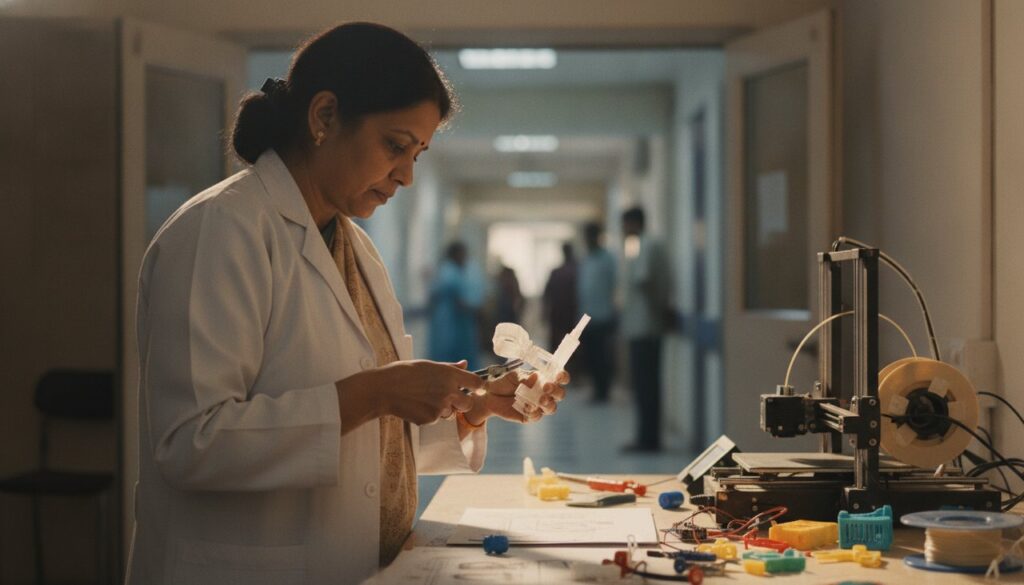
The sterile, fluorescent-lit corridors of Kasturba Hospital in Manipal are a far cry from Silicon Valley’s sleek innovation hubs. Yet, this is where Dr. Meera Nair, an orthopedic resident, found herself staring at a broken splint that had failed one of her patients. It wasn’t the first time she’d seen this, and she knew it wouldn’t be the last. The frustration was palpable. But Meera did something different. She didn’t wait for a grant, a nod from an institutional authority, or an engineering degree. She simply went to the hospital’s makeshift workshop and started tinkering with 3D printing materials. Within weeks, she had a prototype that was not only more effective but also cheaper. How did she do it? The answer lies in dispelling the myth that innovation in medicine requires deep pockets and formal approval.
Myth: You Need a Grant to Innovate
It’s a comforting belief that innovation requires hefty funding—from government grants, philanthropic initiatives, or venture capital. This mindset, however, can paralyze potential innovators. In reality, the early stages of innovation require more grit than money. Consider this: the average startup grant from the National Institutes of Health (NIH) is around $50,000, but this often comes with strings attached, including equity dilution or restricted use of funds. On the other hand, many breakthrough innovations have started with far less.
“The biggest barrier to innovation isn’t the lack of funding, but the belief that funding is a prerequisite.”
Reality: Resourcefulness Trumps Resources
In the Indian clinical context, resource constraints are the norm. Hospitals are often understaffed, equipment is outdated, and budgets are tight. However, these limitations can be a fertile ground for innovation. Let’s break down how you can get started without waiting for a grant:
1. Identify the Real Problem
Innovators like Dr. Meera didn’t start with a grand vision; they started with a real problem. What’s the one issue you encounter repeatedly? Is it a device that fails often or a process that takes too long? Write it down. The more specific, the better.
2. Use What’s on Hand
Your hospital might not have a state-of-the-art lab, but it has a community. Collaborate with other departments, use existing workshops, and tap into local suppliers. Dr. Meera sourced biodegradable materials from a local vendor willing to provide small quantities for experimentation.
3. Leverage Local Talent
You don’t need an engineering degree to innovate. Local engineering colleges are often on the lookout for real-world projects for their students. Partner with them for design and prototyping. In fact, many students are eager to take on projects that have real-world implications.
4. Start Small, Fail Fast
Don’t aim for perfection on the first try. Develop a minimum viable product (MVP) and test it in a controlled setting. Dr. Meera’s initial prototypes were rough but functional, allowing her to gather feedback and iterate quickly.
5. Document and Validate
Keep detailed records of your process, failures, and successes. This documentation will be invaluable if you later decide to pursue formal funding or regulatory approval. It also helps in learning from mistakes and successes alike.
What to Do Instead: Embrace the Scrappy Path
Innovation in medicine doesn’t have to be a grand affair. It can start with something as simple as a broken splint and a desire to make things better. The scrappy path to innovation thrives on resourcefulness, collaboration, and a relentless focus on solving real problems. Here’s how you can embrace it:
-
Identify a specific, recurring problem you’re passionate about solving.
-
Make a list of resources and skills you already have access to.
-
Reach out to local engineering or design students for collaboration.
-
Create a basic prototype using available materials.
-
Test your prototype in a real-world setting and gather feedback.
-
Iterate on your design based on feedback and document your process.
Conclusion: Your Innovation Journey Begins Now
The belief that significant funding is a prerequisite to innovation is a myth that needs dismantling. Dr. Meera didn’t wait for a grant; she started with what she had, where she was. Her story is not an exception but a template. If you’re a medical professional in India, facing daily frustrations with devices or processes that don’t work as they should, remember this: the power to innovate is in your hands. Start small, think big, and most importantly, start today.