
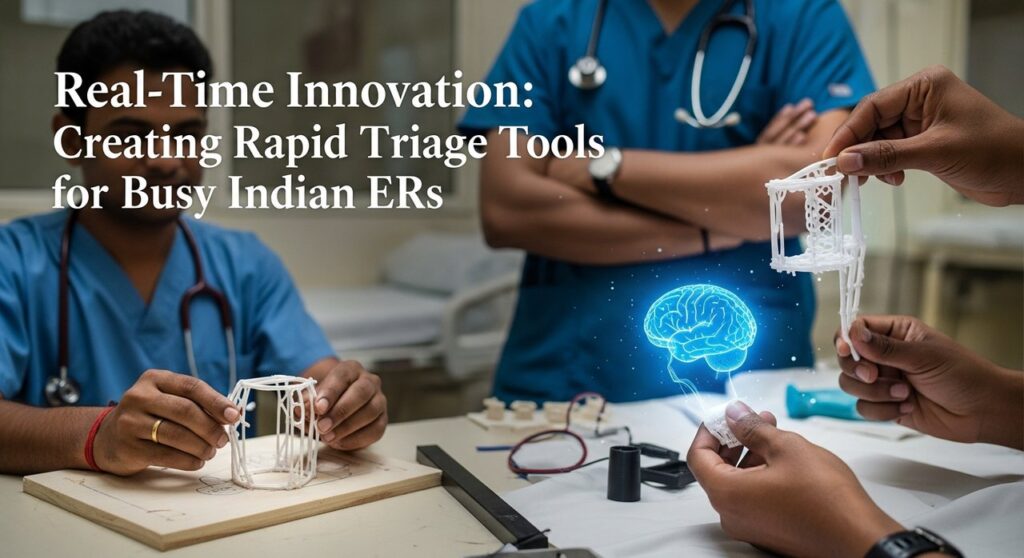
Real-Time Innovation: Creating Rapid Triage Tools for Busy Indian ERs
A patient arrives at a bustling Indian emergency room, clutching their chest, gasping for air. It’s a scene repeated countless times across the country, where emergency departments (EDs) are a battleground of time versus life. With an overwhelming patient load and limited resources, Indian healthcare professionals face a daunting task, making swift, accurate decisions that can mean the difference between life and death. Here lies a critical question: How can we equip our ERs to handle such pressure with precision and speed?
The Challenge of Triage in India
Emergency rooms in India are often a chaotic symphony of sounds and urgency. Yet, beneath the surface, there’s a persistent challenge, efficient triage. While the concept of triage is not new, its execution in India is fraught with issues. Overcrowded waiting rooms, insufficient staff, and the sheer diversity of patient cases make traditional triage methods cumbersome and often ineffective.
In India, a typical ER could see over 200 patients daily, with each case varying drastically in urgency and complexity.
The implications are severe. Delayed or inaccurate triage can lead to critical patients waiting too long, while others with less urgent needs consume valuable medical resources. The resulting bottleneck affects patient outcomes and strains the healthcare system further. The answer to this conundrum may lie in leveraging technology, specifically, AI-powered triage systems.
AI-Powered Triage: A Game-Changer?
Enter ERTRIAGE, an AI-supported triage system that promises to revolutionize how emergency departments manage patient inflow. Designed to integrate seamlessly into existing workflows, ERTRIAGE rapidly analyzes over 50 clinical data points, such as symptoms, vital signs, and medical history, to classify patients by acuity with remarkable speed and accuracy.
- Data Collection: Within seconds, ERTRIAGE collects and processes vital patient information, reducing the burden on busy medical staff.
- AI Analysis: Utilizing robust machine learning algorithms, the system evaluates the data and provides a triage recommendation in under three minutes.
- Integration: ERTRIAGE connects with existing hospital systems, ensuring a smooth, interoperable workflow with minimal training required.
With a 97% accuracy rate, ERTRIAGE is not just a theoretical solution but a proven tool in real-world settings. Hospitals using this system report a 40% reduction in waiting times, improved patient flow, and a significant increase in staff confidence. These numbers suggest a transformative potential, but what does this mean for Indian ERs specifically?
Adapting AI Triage to Indian Contexts
The Indian healthcare landscape is unique, with government hospitals often operating under severe resource constraints. The integration of AI in such environments must be both adaptable and resilient. ERTRIAGE’s hybrid architecture offers a solution, capable of operating offline in scenarios where connectivity is a challenge, ensuring operational continuity and enhanced cybersecurity.
Moreover, the cost factor cannot be ignored. While sophisticated tools can seem out of reach for budget-constrained institutions, the efficiency gains and improved patient outcomes make a compelling case for investment. Consider the reduction in unnecessary admissions and the ability to prioritize truly critical cases, these benefits alone can offset initial costs.
ERTRIAGE bridges the gap between nurse-led triage and physician expertise, reducing decision latency and enhancing the precision of emergency care.
Learning from Implementation: A Real-World Example
Let’s look at an example from Sir J.J. Hospital in Mumbai, where ERTRIAGE was piloted. Initially, there was skepticism, could a device really make such a significant impact? However, as the system was implemented and staff became familiar with its capabilities, the shift was palpable. Nurses reported less stress, doctors found their interventions more timely, and patients experienced shorter wait times.
The key to success here was not just the technology itself but the support and training provided to the staff. By respecting their clinical expertise and teaching them the building parts they were unfamiliar with, like AI data interpretation and system integration, the hospital staff became active participants in the innovation process.
The Concrete Steps Forward
If we are to replicate such success across India, a few steps are crucial:
- Identify and Prioritize Needs: Each hospital must assess its unique challenges and patient demographics to tailor the AI system accordingly.
- Invest in Training: Equip staff with the necessary skills to operate new technologies effectively, ensuring they are comfortable and confident in its use.
- Collaborate with Innovators: Engage with medical innovation labs like MICE Labs to co-create solutions that fit the Indian context and constraints. Learn how to harness feedback for low-budget innovation.
- Monitor and Iterate: Continuously evaluate the system’s performance and make iterative improvements based on real-world feedback and outcomes.
For Indian healthcare professionals, the path to innovation does not require an engineering degree or a hefty grant. It requires a willingness to embrace new tools, adapt them to local needs, and collaborate with partners who understand the intricacies of the Indian medical environment. The journey is challenging, but as the ER in Mumbai demonstrates, it is entirely possible, and immensely rewarding.
Conclusion: The Future of Indian ERs
AI-powered triage, like ERTRIAGE, could be the turning point for Indian emergency rooms struggling with resource constraints and patient overload. By adopting such technologies and tailoring them to local contexts, Indian hospitals can not only improve efficiency but also enhance patient care quality. Ultimately, the real triumph lies in the hands of Indian clinicians, ready to embrace and drive this transformation.
As we look to the future, the question is not whether Indian ERs can innovate in real-time, but how quickly they will rise to the challenge. The tools are here, the expertise is available, and the need is urgent. It’s time to act.