
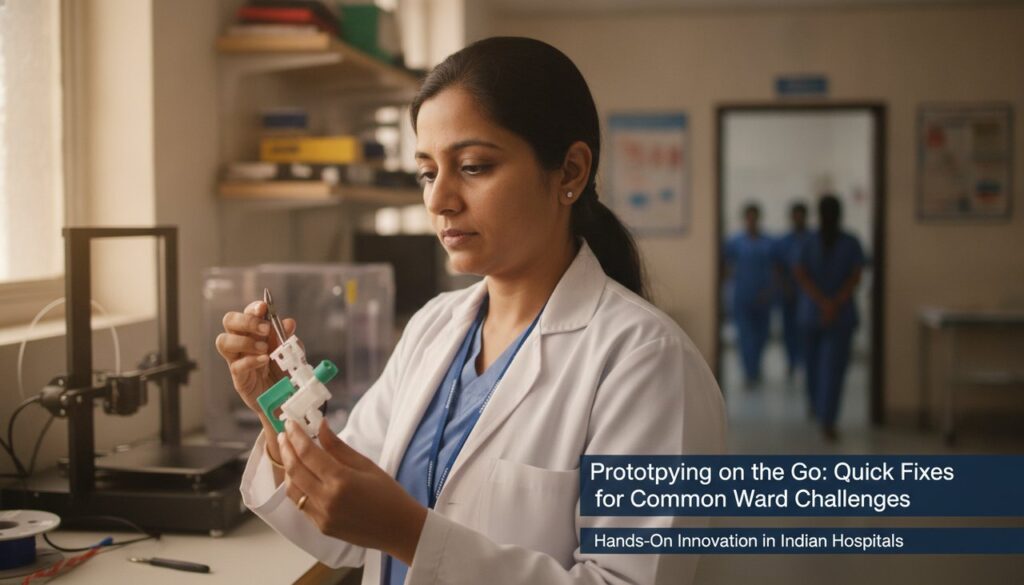
Prototyping on the Go: Quick Fixes for Common Ward Challenges
Picture this: you’re in the middle of a packed shift at a bustling government hospital in Mumbai, juggling patient rounds, managing an overburdened team, and facing unexpected equipment failures. A critical patient needs an immediate intervention, but the standard equipment isn’t cutting it. You know there’s a better way, but time, resources, and red tape seem insurmountable. What if you could prototype a solution right there in the ward?
The Reality of Ward Challenges
In Indian hospitals, the constraints are as real as the patients. Resources are limited, wards are crowded, and time is a luxury clinicians can’t afford. Yet, innovation often emerges from necessity. Many clinicians have a clear understanding of the problems but lack the pathway to develop practical solutions. While prototyping is a buzzword in design circles, its application in real-time clinical settings remains elusive. Let’s confront the real costs of sticking to suboptimal solutions and explore how simple prototyping can turn frustration into innovation.
Prototyping in the ward isn’t about high-tech labs; it’s about making the most of what’s around you to solve immediate problems.
Case Study: The IV Drip Dilemma
Consider the IV drip setup, a staple in any hospital ward. Despite its ubiquity, it often fails at critical junctures, leading to delays in patient care. The problem isn’t just technical, it’s about usability and adaptability in high-pressure environments. What if you could prototype a better IV solution based on your daily encounters? A recent experiment at MICE Labs demonstrated how clinicians used local materials to create an improved drip chamber that reduced blockages and was easier to monitor. This wasn’t about reinventing the wheel; it was about refining it to roll better under local conditions.
Step-by-Step: Prototyping on the Go
- Identify the Real Problem: Start with a specific challenge you face repeatedly. Is it an equipment failure, a process bottleneck, or a communication gap? Narrowing down the problem gives you a clear target for your prototype.
- Gather Available Resources: Look around your ward. What materials can you repurpose? Cardboard, tape, syringes, these aren’t just tools; they’re the building blocks of your prototype.
- Sketch and Test: Sketch out your idea on paper. This doesn’t have to be perfect. The goal is to visualize the solution. Once you have a sketch, create a basic model and test it in a safe environment.
- Iterate and Refine: Don’t fall in love with your first prototype. Test it under different scenarios, gather feedback from colleagues, and refine it. Iteration is key to moving from a makeshift fix to a viable solution.
- Document and Share: Document your process, the materials used, and the outcomes. Share this with other clinicians to get further insights and possibly improve your design.
Prototyping isn’t just about the end product; it’s about the process of learning and improving with each iteration.
Breaking Down Misconceptions
One common misconception is that prototyping requires sophisticated tools and a dedicated lab. The reality is far simpler. The most effective prototypes often start with low-cost, readily available materials. The purpose is not to create a polished product but to test and validate ideas quickly and inexpensively. By adopting this mindset, you can prototype solutions that are practical, scalable, and tailored to the unique demands of the Indian healthcare setting.
The Cost of Inaction
Sticking to outdated or inefficient solutions comes at a cost. Delayed treatments, increased patient dissatisfaction, and clinician burnout are just the beginning. In contrast, a culture of rapid prototyping can lead to faster, more effective interventions. It empowers clinicians to take control of their environment and make tangible improvements without waiting for top-down changes.
| Scenario | Cost of Inaction | Benefit of Prototyping |
|---|---|---|
| Delayed IV Drip Setup | Increased patient discomfort, risk of complications | Improved patient outcomes, streamlined processes |
| Workflow Bottlenecks | Extended patient wait times, clinician frustration | Efficient patient flow, reduced stress |
| Equipment Failures | Interrupted care, potential for errors | Enhanced reliability, proactive problem-solving |
Real-World Impact: When Every Minute Matters
Prototyping isn’t purely about creating; it’s about problem-solving when the stakes are high. In critical scenarios, such as patient triage, every second counts. Rapid prototyping can lead to the development of devices that significantly cut down triage times, as seen in initiatives like these devices that emerged from clinician-driven innovation.
The Path Forward
So, what’s stopping you from starting your own prototyping journey? The path isn’t as daunting as it seems. With a clear focus, a willingness to experiment, and the support of your peers, you can begin to innovate right from your ward. It’s about time we embrace the discomfort of the problems we face and turn them into catalysts for meaningful change.
Prototyping is a mindset, not a method confined to labs. It’s about leveraging your clinical expertise to design solutions that work within your context. By doing so, you not only improve patient care but also inspire a culture of innovation in your hospital. Remember, the next great medical device could very well start from a sketch on a piece of paper during a busy shift.